 IG
IG FOREX.com
 CMC Markets
 XTB
XTB eToro
eToro Capital.com
 AvaTrade
 XM
XM Pepperstone
 FP Markets
 Tickmill
 HFM Markets
Best US Forex Brokers of 2026
Written by Steven Hatzakis
Director of Online Broker Research

Edited by John Bringans
Managing Editor

Fact-checked by Joey Shadeck
Research Analyst
Steven HatzakisDirector of Online Broker Research
Steven Hatzakis is the Global Director of Online Broker Research for ForexBrokers.com. He is a forex industry expert and an active fintech and crypto researcher.


The best U.S. forex brokers in 2026 are tastyfx, Interactive Brokers, and FOREX.com.
The U.S. maintains a strict regulatory structure designed to protect traders and ensure financial stability. Brokers must register with the Commodity Futures Trading Commission (CFTC), become members of the National Futures Association (NFA), and comply with tighter trading rules.
What does this mean? A trading environment that prioritizes transparency and consistent standards for retail forex traders. Keep scrolling to find my short list of the best U.S.-regulated forex brokers.
Best US Forex Brokers for 2026
 How we tested
Led by Steven Hatzakis, Director of Online Broker Research, the ForexBrokers.com research team collects thousands of data points across hundreds of variables. We evaluate features important to every kind of forex trader, including beginners and active traders. We carefully track data on international regulators, commissions, and spreads to rate forex brokers across our proprietary testing categories.
Our researchers open personal brokerage accounts and test all available platforms on desktop, web, and mobile for each broker reviewed on ForexBrokers.com. Learn more about how we test.
How Steven chose the best U.S. forex brokers
Because of the United States’ uniquely stringent regulatory framework, my first step wasn't looking at spreads or charting tools, it was digging into the NFA BASIC database to verify which brokers actually hold active Retail Foreign Exchange Dealer (RFED) licenses and maintain the mandatory $20 million in regulatory capital.
With that out of the way, I logged in to see how the remaining brokers handle the day-to-day friction of trading under the strict CFTC rules. I wanted to experience how their order tickets manage mandatory FIFO (first-in, first-out) execution and the hard 50:1 leverage caps. I spent time running technical analysis through tastyfx's ProRealTime setup and FOREX.com's TradingView integration to see which felt more responsive during active market hours. I also looked closely at execution models, contrasting Interactive Brokers' commission-based interbank pricing with the standard spread markups at OANDA and Charles Schwab.
Because U.S. rules strictly prohibit hedging within the same account, I paid special attention to how well each platform's risk management tools help you navigate those limits without feeling overly restrictive.
- Minimum Deposit: £1
- Trust Score: 99
- Tradeable Symbols (Total): 19537
IG offers the ultimate comprehensive trading package, featuring excellent trading and research tools, industry-leading education, and an extensive range of tradeable markets. Read full review
- #1 Overall Broker in our ForexBrokers.com 2026 Awards.
- Highest Trust Score in 2026; most trusted forex broker.
- tastyfx brings IG access to U.S. forex traders.
- IG’s web platform requires some manual setup.
- MT5 is not available on IG.
- Only ~80 symbols available via MetaTrader.
- IG’s DailyFX news and research site has been discontinued.
- Minimum Deposit: $0
- Trust Score: 99
- Tradeable Symbols (Total): 8500
Interactive Brokers is a highly trusted multi-asset broker with an extensive offering of tradeable global markets. It delivers competitive fees and high-quality research and education, as well as a modern, institutional-grade trading platform suite. Read full review
- Access 170 markets in 40 countries; 28 base currencies.
- TradingView launched for both manual and algo traders.
- TWS desktop offers powerful tools for advanced strategies.
- New IBKR InvestMentor app offers beginner-friendly finance courses.
- TWS platform is overwhelming for beginners.
- No MetaTrader suite or copy trading tools available.
- $2 minimum commission can be costly for small trade sizes.
- Minimum Deposit: $100
- Trust Score: 99
- Tradeable Symbols (Total): 7000
FOREX.com is a trusted brand that delivers an excellent trading experience for forex and CFDs traders across the globe. It offers a wide range of markets and provides an impressive suite of proprietary platforms – alongside limited access to MetaTrader. Read full review
- Trading Academy is great for all experience levels.
- Advanced charting through TradingView with 5,500+ symbols.
- Pro-grade trading tools on web and desktop.
- Spreads are higher than other low-cost brokers.
- Pricing is average unless you qualify for active trader discounts.
- Stock and futures trading require a separate StoneXone account.
- Minimum Deposit: €50
- Trust Score: 99
- Tradeable Symbols (Total): 5500
Plus500 is a trusted global brand that offers an easy-to-use trading platform for online traders, alongside access to a thorough selection of CFDs. Share trading is available, but only via its Plus500 Invest product offering. Read full review
- Beginner-friendly web platform with clean interface and free demo account.
- +Insights tool combines data from Trading Central and FactSet.
- Consistent charting experience across web and mobile platforms.
- Offers share and futures trading via Plus500 Invest and Futures.
- Platform lacks advanced tools for active traders.
- EUR/USD spreads averaged 1.3 pips in May 2025.
- No integrated news headlines across platforms.
- Research and video content lack depth and frequency.
- Minimum Deposit: $0
- Trust Score: 92
- Tradeable Symbols (Total): 4172
A trusted global brand, OANDA stands out for its reputation and quality market research. Its regulatory track record is strong, and its support for third-party features bolsters its overall offering. Read full review
- MarketPulse and Trade Tap Blog offer daily research and analysis.
- OANDA Trade app is user-friendly with solid functionality.
- TradingView and MT4 support with VPS hosting.
- Algo Labs supports API trading (not in Australia).
- Fewer YouTube video updates than peers.
- New Smart videos education series are mostly platform tutorials.
- Spreads are high compared to the best overall brokers.
- OANDA Trade platform trails best-in-class leaders.
- Minimum Deposit: $0
- Trust Score: 99
- Tradeable Symbols (Total): 85
tastyfx, the U.S. arm of IG's forex business, offers the ultimate comprehensive trading package, featuring excellent trading and research tools, industry-leading education, and an extensive range of tradeable markets. Read full review
- Offers signals from AutoChartist and PIA First.
- Supports algo trading on MT4 and ProRealTime.
- High-volume traders earn rebates via volume-based cashback.
- Options and futures trading require a separate tastytrade account.
- IG Academy and IGTV are not yet integrated into tastyfx.
- ProRealTime charts cost $40/month if under 4 lots per month.
CFDs are complex instruments and come with a high risk of losing money rapidly due to leverage. Between 51% and 89% of retail investor accounts lose money when trading CFDs. You should consider whether you understand how CFDs work and whether you can afford to take the high risk of losing your money.
Commodity Futures Trading Commission (CFTC) & National Futures Association (NFA)
- The United States is a Trusted, Tier-1 regulatory jurisdiction. Learn more about international forex regulation and why it’s important.
- The Commodity Futures Trading Commission (CFTC) oversees U.S. derivatives markets, including retail forex, while the National Futures Association (NFA) serves as the industry self-regulatory organization under CFTC supervision.
- Only firms registered with the CFTC as Futures Commission Merchants (FCMs) or Retail Foreign Exchange Dealers (RFEDs) and that are members of NFA can legally offer off-exchange retail forex trading to U.S. residents.
- Always confirm your broker’s registration status and NFA membership using the free NFA BASIC database.
Best forex brokers in the US
1. tastyfx - Best overall broker, most trusted
tastyfx takes the top position in this year’s U.S. forex rankings because it delivers a complete trading experience built on IG’s long-established infrastructure. The rebranding from IG US doesn’t change the underlying mechanics; execution quality, pricing, platform stability, and research all carry over intact. What makes tastyfx compelling for U.S. traders is how these components work together to support consistent day-to-day trading across a wide range of currency pairs.
Trading platforms: tastyfx offers access to MetaTrader4 and ProRealTime, which are two platforms well suited to traders who rely on structured charting workflows or want to automate parts of their process. ProRealTime, in particular, remains one of the stronger desktop charting environments available to U.S. traders, with reliable order handling and a layout that supports detailed technical analysis. tastyfx also benefits from IG’s liquidity relationships and routing framework, allowing it to process larger orders without unnecessary slippage, which matters for traders who scale positions or work in fast-moving markets.
Trading fees: Spreads remain competitive across major and minor pairs, and traders can supplement their analysis with third-party signals from AutoChartist and PIA First, which are tools that add structure to trade planning without dictating strategy. Research produced across IG’s global network continues to inform the tastyfx experience, giving traders access to market commentary that is generally timely and practical.
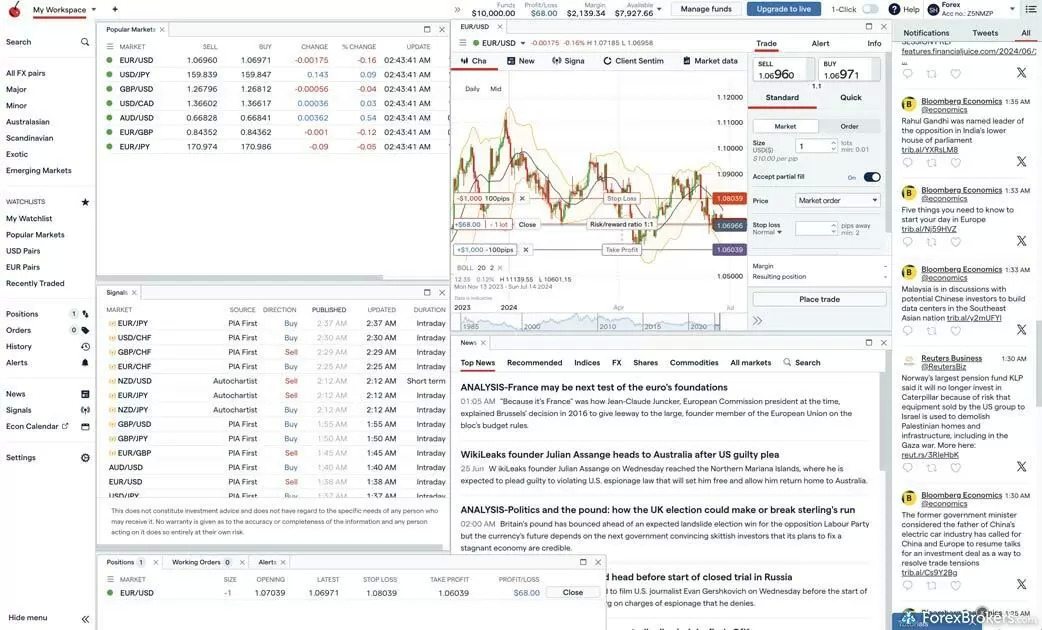
Tastyfx web platform in fullscreen layout with watchlist signals news positions charts and news headlines in view.
Steven's take:
"I’ve found tastyfx to be a straightforward platform that still has enough depth for serious traders. The layout makes it easy to stay oriented, and the execution quality reflects IG’s scale behind the scenes."
Steven Hatzakis
Director of Online Broker Research
The platform environment is clean and navigable, and U.S. clients operate under CFTC and NFA oversight, rules that shape leverage, disclosures, and capital standards. For traders who want a stable, well-built forex workflow backed by a publicly traded parent with extensive regulatory coverage, tastyfx offers one of the most complete U.S.-available packages.
2. Interactive Brokers - Best for professional traders
Interactive Brokers (IBKR) remains one of the strongest choices for seasoned forex traders because its platform suite is built to support complex, data-driven decision making. The combination of TWS, IBKR Desktop, and the web-based Client Portal covers a wide spectrum of trading needs, from high-touch manual execution to structured, multi-asset workflows. Many retail traders find the layout demanding, but for traders who rely on customization, order control, and market depth, that complexity is often a feature rather than a drawback. Note that in the U.S., forex is offered only to institutional clients, so retail and professional clients cannot trade forex with IBKR unless they meet the definition of an Eligible Contract Participant, holding at least $10 million in assets. Spot currencies are still available to purchase, but without any leverage.
Trading fees and execution: What distinguishes IBKR in forex is its execution framework. Instead of marking up spreads, IBKR aggregates pricing from a large group of interbank dealers and charges a commission per trade. The result is transparency: our live pricing analysis recorded an average EUR/USD spread of 0.226 pips against a $4.00 commission per standard lot, for an all-in round-turn cost of 0.626 pips. This structure particularly benefits traders who routinely work with standard-lot order sizes or who have strategies that demand precise fills. High-volume traders can also qualify for reduced minimum commissions, with the $2 minimum per order falling to $1.50 above a billion in monthly trade value, $1.25 above two billion, and $1 above five billion.
Research and analysis: IBKR’s platforms integrate headlines from major newswires, economic calendars, and a broad library of third-party services. The Traders’ Insight blog and additional in-house content add context during active market periods, while premium providers fill in the specialized analysis that many advanced traders rely on. The breadth can be overwhelming at first, but it gives experienced traders the ability to shape their information flow rather than work around preset defaults.

An example of the daily analysis and research to be found on the Traders Insights blog. Featured here is an article from Darren Chu describing USDJPY Bull Flag pattern analysis.
IBKR is not designed to simplify forex trading. It's designed to give knowledgeable traders the tools, data, and routing control needed to execute sophisticated strategies. For those who prefer depth over ease, its platform suite remains one of the most capable options available to U.S. residents who qualify for forex access.
3. FOREX.com - Great for educational content
FOREX.com is backed by StoneX Group Inc. and has built its reputation on pairing a broad product offering with platforms that feel approachable for a wide range of traders. For U.S. clients, the focus is squarely on spot forex under CFTC and NFA rules, but the underlying technology is the same framework that supports thousands of symbols globally. What makes FOREX.com stand out in this guide is how well its tools and education work together for traders who want structure around their learning curve.
Trading platforms: FOREX.com’s Advanced Trading desktop platform and Web Trading platform give traders two clear paths: a more configurable, tool-heavy environment for active users, and a simpler browser-based experience for those who prefer clean navigation. Both are powered by strong charting, with TradingView integration providing familiar layouts, multiple timeframes, and a wide range of indicators. MetaTrader 4 and MetaTrader 5 remain available for traders who prefer that ecosystem, which is helpful if you already have templates or EAs you rely on. Performance analytics, built from the Chasing Returns acquisition, add another layer by surfacing patterns in your own behavior rather than just market data.
Research and education: Education is where FOREX.com earns its spot in this guide. The Trading Academy, along with written content and video series, gives traders a detailed, modular way to build skills over time. Courses are organized by experience level, and the combination of interactive lessons, quizzes, and regular video updates makes it easier to connect platform features with real market situations.

An example of a beginner-level educational course on FOREX.com, including an accompanying video.
4. Charles Schwab - Great support and platform suite
Charles Schwab brings its scale as a large, multi-asset institution into the forex space, but keeps trading tightly centered on the thinkorswim platform. For U.S. residents who already rely on Schwab for stocks, options, or futures, adding forex on thinkorswim can be a logical extension rather than a separate workflow. The platform’s charting includes hundreds of indicators, flexible layouts, and tools like tick charts that help active traders track short-term price shifts.
Schwab’s broader ecosystem matters here, too. Support staff are generally knowledgeable across markets, and the firm’s extensive research and education, while not forex-specific, gives traders a steady stream of market context. The trade-off is that forex access is limited to thinkorswim and comes with a 10,000-unit minimum trade size, which won’t suit everyone. For platform-focused traders who want forex inside a larger brokerage relationship, Schwab is a sensible fit.
5. OANDA - Trusted broker, great research
OANDA is a long-established, research-driven broker that appeals to U.S. traders who want clear market commentary and an easy-to-navigate platform. Its regulatory footprint spans several Tier-1 jurisdictions, and in the U.S. it is one of the few firms permitted to offer retail spot forex. The Trade platform and mobile app are intuitive, and support for TradingView, MT4, and API connectivity gives active traders flexibility in how they build and test their workflow.
Costs are the main consideration. Standard spreads tend to run higher than the industry average. Traders who deposit at least $10,000 can access OANDA’s Core Pricing, which lowers spreads but adds a per-side commission. For heavier traders, the Elite Trader program adds further rebates. For those who prioritize research quality and usability over the lowest spreads, OANDA remains a practical option.
Best MetaTrader brokers in the US
Compare U.S. registered forex brokers that offer MetaTrader 4 or MetaTrader 5 in the table below. This broker list is sorted by my overall rankings of the top forex brokers.
 tastyfx
 FOREX.com
 OANDA
OANDA
Our testing
Why you should trust us
Steven Hatzakis is a well-known finance writer, with 25+ years of experience in the foreign exchange and financial markets. He is the Global Director of Online Broker Research for Reink Media Group, leading research efforts for ForexBrokers.com since 2016. Steven is an expert writer and researcher who has published over 1,000 articles covering the foreign exchange markets and cryptocurrency industries. He has served as a registered commodity futures representative for domestic and internationally-regulated brokerages. Steven holds a Series III license in the US as a Commodity Trading Advisor (CTA).
All content on ForexBrokers.com is handwritten by a writer, fact-checked by a member of our research team, and edited and published by an editor. Our ratings, rankings, and opinions are entirely our own, and the result of our extensive research and decades of collective experience covering the forex industry.
Ultimately, our rigorous data validation process yields an error rate of less than .1% each year, providing site visitors with quality data they can trust. Click here to learn more about how we test.
More about US forex markets and regulation
The United States maintains one of the world’s strictest regulatory environments for retail forex trading, anchored by a dual-agency framework led by the Commodity Futures Trading Commission (CFTC) and the National Futures Association (NFA). The CFTC serves as the primary federal regulator for derivatives markets, including leveraged forex trading. Any firm offering retail forex to U.S. residents must be registered as a Retail Foreign Exchange Dealer (RFED) or Futures Commission Merchant (FCM) with the CFTC. The NFA, an industry self-regulatory organization, enforces compliance through ongoing supervision, routine audits, and mandatory disclosure standards.
U.S.-regulated brokers must meet some of the world’s highest financial and operational thresholds, including maintaining substantial net capital, segregating client funds, and adhering to strict reporting requirements. All registered entities can be verified using the NFA’s Background Affiliation Status Information Center (BASIC) database, which lists registration details, disciplinary actions, and regulatory status. This verification step is essential: many offshore brokers claim to accept U.S. clients but do so without proper authorization, placing traders at significant risk.
In addition to federal oversight, the U.S. structure prohibits certain products, most notably CFDs, which cannot be offered to U.S. residents. Forex trading instead operates within a tightly controlled leverage framework, capped at 50:1 for major pairs and 20:1 for minors, designed to protect retail traders by limiting excessive risk.
Against this robust backdrop, our research team independently validates every broker’s regulatory status, ensuring they are duly registered with the CFTC and NFA, or in cases where the broker is not U.S.-regulated, clearly outlining the implications for American traders. Learn more Trust Score and the 100+ regulators monitored globally by ForexBrokers.com.
How we tested
At ForexBrokers.com, our online broker reviews are based on our collected quantitative data as well as the observations and qualified opinions of our expert researchers. Each year we publish tens of thousands of words of research on the top forex brokers and monitor dozens of international regulator agencies (read more about how we calculate Trust Score here).
Mobile testing is conducted on modern devices that run the most up-to-date operating systems available:
- For Apple, we use MacBook Pro laptops running macOS 15.3, and the iPhone XS running iOS 18.3.
- For Android, we use the Samsung Galaxy S20 and Samsung Galaxy S23 Ultra devices running Android OS 15.
All websites and web-based platforms are tested using the latest version of the Google Chrome browser.
Our researchers thoroughly test a wide range of key features, such as the availability and quality of watch lists, mobile charting, real-time and streaming quotes, and educational resources – among other important variables. We also evaluate the overall design of the mobile experience, and look for a fluid user experience moving between mobile and desktop platforms.
Compare US Brokers
Popular Forex Guides
- Best Forex Trading Apps for 2026
- Best Forex Brokers for Beginners of 2026
- International Forex Brokers Search
- Best Forex Brokers for 2026
- Best Low Spread Forex Brokers for 2026
- Best Copy Trading Platforms for 2026
- Best Brokers for TradingView for 2026
- Best MetaTrader 4 (MT4) Brokers for 2026
- Compare Forex Brokers
Forex Risk Disclaimer
There is a very high degree of risk involved in trading securities. With respect to margin-based foreign exchange trading, off-exchange derivatives, and cryptocurrencies, there is considerable exposure to risk, including but not limited to, leverage, creditworthiness, limited regulatory protection and market volatility that may substantially affect the price, or liquidity of a currency or related instrument. It should not be assumed that the methods, techniques, or indicators presented in these products will be profitable, or that they will not result in losses. Read more on forex trading risks.
About the Editorial Team
Steven Hatzakis is the Global Director of Online Broker Research for ForexBrokers.com. Steven previously served as an Editor for Finance Magnates, where he authored over 1,000 published articles about the online finance industry. A forex industry expert and an active fintech and crypto researcher, Steven advises blockchain companies at the board level and holds a Series III license in the U.S. as a Commodity Trading Advisor (CTA).
John Bringans is the Managing Editor at ForexBrokers.com. An experienced media professional, John has a decade of editorial experience with a background that includes key leadership roles at global newsroom outlets. He holds a Bachelor’s Degree in English Literature from San Francisco State University, and conducts research on forex and the financial services industry while assisting in the production of content.
Joey Shadeck is a Content Strategist and Research Analyst for ForexBrokers.com. He holds dual degrees in Finance and Marketing from Oakland University, and has been an active trader and investor for close to ten years. An industry veteran, Joey obtains and verifies data, conducts research, and analyzes and validates our content.