 IG
IG FOREX.com
 CMC Markets
 XTB
XTB eToro
eToro Capital.com
 AvaTrade
 XM
XM Pepperstone
 FP Markets
 Tickmill
 HFM Markets
Best CFD Trading Platforms for 2026

Written by Steven Hatzakis
Director of Online Broker Research

Edited by John Bringans
Managing Editor

Fact-checked by Joey Shadeck
Research Analyst

Reviewed by Blain Reinkensmeyer
Managing Partner
Steven HatzakisDirector of Online Broker Research
Steven Hatzakis is the Global Director of Online Broker Research for ForexBrokers.com. He is a forex industry expert and an active fintech and crypto researcher.


 Why you can trust us
Led by Steven Hatzakis, Director of Online Broker Research, the ForexBrokers.com research team collects thousands of data points across hundreds of variables. We evaluate features important to every kind of forex trader, including beginners and active traders. We carefully track data on international regulators, commissions, and spreads to rate forex brokers across our proprietary testing categories.
Our researchers open personal brokerage accounts and test all available platforms on desktop, web, and mobile for each broker reviewed on ForexBrokers.com. Learn more about how we test.
Contracts for Difference (CFDs) are powerful financial tools that allow you to trade the price movements of thousands of global assets, from Nvidia shares to gold and crypto, without ever owning the underlying security.
However, the flexibility and leverage that make CFDs attractive also introduce significant complexity (and risk). The difference between a successful trade and a frustrating experience often comes down to the reliability of your platform and the transparency of its pricing.
I’ve been reviewing CFD trading platforms for over 10 years; my review process includes collecting and verifying spread data, hand-testing trading platforms and mobile trading apps, and validating each broker’s regulatory status across 100+ international jurisdictions.
This strict methodology is designed to give you a list of brokers that deliver transparent, reliable access to CFD markets. Here are my recommendations for the best CFD trading platforms for 2026.
| Company | Average spread (EUR/USD) - Spread-only account | Minimum Deposit | Overall Rating |
 IG IG
|
0.91 | £1 |
|
 CMC Markets CMC Markets
|
1.3 | $0 |
|
 eToro eToro
|
1 | $50-$10,000 |
|
 Saxo Saxo
|
1.0 | $0 |
|
 Interactive Brokers Interactive Brokers
|
N/A | $0 |
|
Best CFD Platforms
I've been in the forex and CFD industry for 25+ years and I’ve tested more than 60 of the best CFD brokers. I verify regulatory licenses (learn more about Trust Score), analyze average spread data, and test the best trading platforms (learn more about how we test brokers). I only recommend platforms that hold reputable regulatory licenses and are safe for retail CFD traders. Here are the best CFD trading platforms for 2026.
- Minimum Deposit: £1
- Trust Score: 99
- Tradeable Symbols (Total): 19537
IG offers the ultimate comprehensive trading package, featuring excellent trading and research tools, industry-leading education, and an extensive range of tradeable markets. Read full review
- #1 Overall Broker in our ForexBrokers.com 2026 Awards.
- Highest Trust Score in 2026; most trusted forex broker.
- tastyfx brings IG access to U.S. forex traders.
- IG’s web platform requires some manual setup.
- MT5 is not available on IG.
- Only ~80 symbols available via MetaTrader.
- IG’s DailyFX news and research site has been discontinued.
- Minimum Deposit: $0
- Trust Score: 99
- Tradeable Symbols (Total): 21710
CMC Markets is well-trusted across the globe, and delivers a terrific trading experience thanks to its 21,710 tradeable instruments and 303 forex pairs, the largest currency lineup in the industry. Read full review
- 21,710 instruments and 303 forex pairs available.
- Next Gen platform is packed with tools and charts.
- Client sentiment and pattern recognition built into the platform.
- Zero minimum deposit and no fee on international wire transfers.
- MetaTrader 4 has fewer symbols and limited product depth.
- Standard-account EUR/USD spread of 1.3 pips has widened year over year.
- No automated trading on CMC's proprietary platform.
- Education lacks progress tracking or interactive features.
- The quantity of research content produced has slowed.
- Minimum Deposit: $50-$10,000
- Trust Score: 97
- Tradeable Symbols (Total): 7441
eToro is a winner for its easy-to-use copy-trading platform, where traders can copy the trades of experienced investors – or receive exclusive perks for sharing their own trading strategies. Read full review
- User-friendly platforms great for casual traders and beginners.
- Offers copy trading and crypto trading.
- VIP-style perks available to eToro Club members.
- eToro is slightly pricier than most of its competitors.
- Algo trading strategies are not supported.
- Mandatory stop-loss and take-profit orders may hinder trading strategies.
- Trading Central is only available to eToro Club members.
- Minimum Deposit: $0
- Trust Score: 99
- Tradeable Symbols (Total): 71000
Saxo is a multi-asset broker with brilliant research and a superb trading platform experience – as well as a stunning selection of over 40,000 securities. Read full review
- 70,000+ instruments including forex options.
- SaxoTrader has advanced tools and a clean interface.
- Offers algo orders, risk tools, and execution by order size.
- TradingView implementation supports Pine Script and API trading.
- No progress tracking or quizzes in education content.
- Platinum and VIP accounts have high deposit requirements.
- SaxoTrader lacks quick-start layouts.
- Can’t drag-to-edit orders on SaxoTrader charts in mobile.
- Minimum Deposit: $0
- Trust Score: 99
- Tradeable Symbols (Total): 8500
Interactive Brokers is a highly trusted multi-asset broker with an extensive offering of tradeable global markets. It delivers competitive fees and high-quality research and education, as well as a modern, institutional-grade trading platform suite. Read full review
- Access 170 markets in 40 countries; 28 base currencies.
- TradingView launched for both manual and algo traders.
- TWS desktop offers powerful tools for advanced strategies.
- New IBKR InvestMentor app offers beginner-friendly finance courses.
- TWS platform is overwhelming for beginners.
- No MetaTrader suite or copy trading tools available.
- $2 minimum commission can be costly for small trade sizes.
CFDs are complex instruments and come with a high risk of losing money rapidly due to leverage. Between 51% and 89% of retail investor accounts lose money when trading CFDs. You should consider whether you understand how CFDs work and whether you can afford to take the high risk of losing your money.
Top picks for CFD brokers
1. IG – Best broker for trading CFDs
IG is my definitive choice for the best CFD trading platform in 2026. It strikes a rare balance, combining the massive inventory of a global institutional broker with an accessible, award-winning platform suite. With a Trust Score of 99 and regulation from reputable regulatory agencies like the FCA and ASIC, IG provides a secure environment that few competitors can match.
CFD offering: You aren't limited to the "major" markets at IG; you can trade over 17,000 CFDs on everything from obscure small-cap stocks cryptocurrencies and commodities like gold. I also appreciate the L2 Dealer platform, which provides Direct Market Access (DMA) for share trading, a critical tool for advanced traders who need to see the order book depth rather than just a simple buy/sell price.
Pricing: IG isn't a discount broker, but its pricing structure is competitive and transparent. I've found that IG's trading costs scale effectively depending on what you trade.
IG offers competitive spreads and a volume-based active trader discount program. Share CFDs incur per-trade commissions unless you're spread betting (U.K. residents only).
For share CFDs, you pay a commission starting at 2 cents per share for U.S. stocks or 0.1% for U.K. stocks. For forex and indices, the cost is built into the spread, which averaged around 0.91 pips on the EUR/USD in the last month we collected data (October 2025). If you are a high-volume trader, the value proposition improves significantly; IG's active trader rebate program can return up to 20% of the spread costs if you meet monthly volume thresholds.
Steven's take
"If you can't find it on IG, you probably can't trade it. With over 17,000 CFDs, the market access here is unrivaled. Whether you are hunting niche global shares or major indices, IG covers it all."
Steven Hatzakis
Director of Online Broker Research

The IG Trading mobile app charting supports trading from the chart, as well as news overlays and multiple concurrent indicators.
2. CMC Markets – 21,710 CFDs, 303 forex pairs
CMC Markets is my top recommendation for traders who want a professional-grade workspace without the institutional barrier to entry. This broker combines a massive library of 21,710 CFDs with its proprietary "Next Generation" platform, available on web and Windows desktop, which I found far more customizable than standard MetaTrader offerings. It is a rare broker that delivers both market range and platform depth.
Deep forex offering: CMC Markets offers a product feature I haven't seen replicated elsewhere: they quote currency pairs both ways. Instead of just trading the standard EUR/USD, you can also trade the inverse USD/EUR. While the math is the same, seeing the chart and price action in the direction of your domestic currency can be a massive psychological advantage for technical analysis. With 303 currency pairs available, nearly half of them quoted both ways, the forex depth is practically unmatched.
Global CFD access: The equity CFD offering is equally impressive, with 15,178 share CFDs covering 23 international markets including Australia, Japan, and Canada. This allows you to trade genuine global macro themes, like shorting Australian miners while going long on Canadian banks, all from a single account. I also appreciate their 35 Share Baskets, which bundle stocks into thematic CFDs like "Renewable Energy" or "Big Tech," allowing you to trade a sector-wide view with a single click rather than managing a dozen individual positions.

The trade ticket on the CMC Markets Next Generation mobile app, showing take profit and stop-loss levels before trade submission.
3. eToro – Best for copy trading
eToro is perhaps best known for helping to pioneer social copy trading, but under the hood, it's a massive CFD engine. With a catalog that has grown to over 9,000 tradeable instruments, eToro offers one of the most diverse CFD selections on the market, covering everything from niche crypto assets to global equities.
Social copy trading: The core of eToro's offering is its CopyTrader technology, which allows you to replicate the positions of top-performing CFD traders in real-time. This can be a powerful tool for beginners; instead of analyzing charts yourself, you can allocate capital to a veteran trader who specializes in commodities like goldor tech stocks and let their strategy drive your portfolio. The "Social Feed" also provides a unique edge, allowing you to gauge real-time sentiment from millions of users before entering a position.
Crypto and global assets: For crypto traders, eToro is a standout. It offers CFDs on over 100 digital assets, a depth that far exceeds most traditional brokers. Whether you are looking to short Bitcoin or go long on an emerging altcoin, the platform makes it seamless. While spreads on standard pairs like EUR/USD can be slightly higher than dedicated ECN brokers, the sheer breadth of assets and the depth of its copy trading offering make eToro an excellent choice for CFD traders.
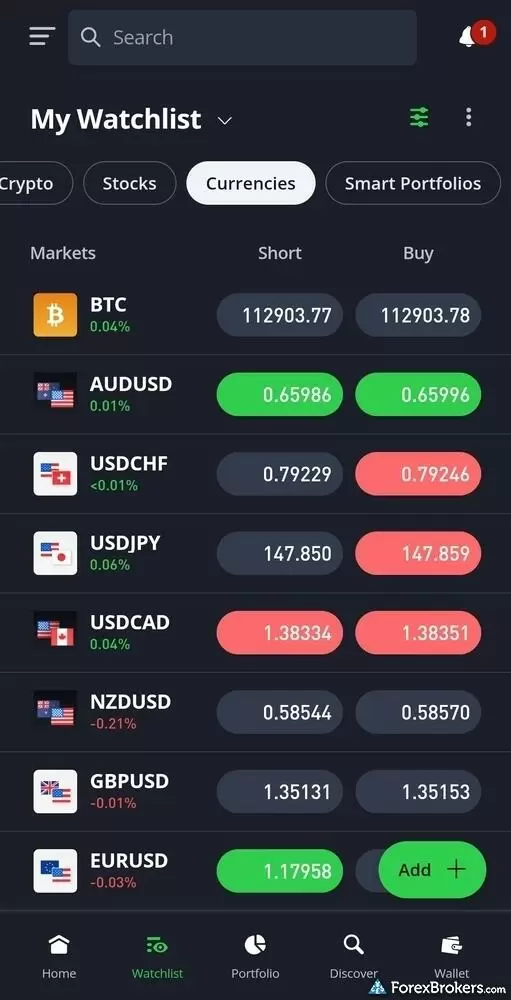
The watchlist on the eToro mobile app shows popular assets for trading.
4. Saxo – Unmatched market range
Saxo combines massive market depth with some of the most intuitive, high-end platforms I’ve ever used. The sheer scope of Saxo’s offering is difficult to overstate. With over 70,000 tradeable instruments, the depth here is staggering. The ability to trade fractional index CFDs is a thoughtful touch, allowing for precise position sizing even on expensive indices – a feature often missing from professional-grade brokers.
Pricing and accounts: Though Saxo has taken a big step in lowering minimum deposits to $0 for the Classic account, Saxo is not a discount broker. Look for minimum commissions, depending on the trade size (i.e., $1 for U.S. stock CFDs). That said, there is the potential for competitive pricing for larger orders and average spreads can drop even further for VIP and Platinum account holders. For instance, fees for stock CFD drop from $0.02 for Classic account holders to $0.015 for Platinum account holders, and down to $0.010 for VIP account holders.
5. Interactive Brokers – Best for professional CFD traders
If you're a professional trader, Interactive Brokers (IBKR) is likely the only CFD trading platform you'll ever need. While IG takes the top spot here for its all-around accessibility, IBKR is unmatched when it comes to raw power and global reach. In my opinion, this is the closest a retail trader can get to an institutional trading desk.
Trading platforms: The flagship Trader Workstation (TWS) is notorious for its steep learning curve, but it's also incredibly powerful. TWS is like a command center for data-driven trading, allowing for complex algo trading orders and deep customization. However, if the depth of TWS feels like overkill for your trading strategy, I highly recommend the newer IBKR Desktop platform. It bridges the gap effectively, offering a streamlined interface that retains the core functionality without the visual clutter.
Other CFD trading platforms I tested
6. City Index – Reliable all-round broker
Backed by StoneX, City Index is a highly trusted broker that excels in market depth and platform quality. With thousands of tradeable instruments covering everything from global shares to 80+ forex pairs, City Index offers a comprehensive catalog of CFDs.
The standout feature is the proprietary Web Trader platform, which integrates sophisticated tools like "PlayMaker" to help you analyze your trading behavior in real-time. While their standard pricing is average compared to the discount leaders, the combination of a top-tier mobile app, TradingView integration, and rock-solid reliability makes City Index a safe, professional choice for the everyday trader.
7. FOREX.com – Trusted brand with great education
FOREX.com delivers a highly trusted, well-rounded experience that works for almost everyone. While it doesn't match the massive market depth of IG or Saxo, its offering of over 5,500 tradeable symbols (including 4,500+ CFDs outside the U.S.) should be more than enough for most retail CFD traders.
FOREX.com's Web Trading platform features deeply integrated TradingViewcharts, allowing you to perform advanced technical analysis without needing third-party software. I also found the "Trading Academy" to be one of the best educational resources in the industry – perfect if you are still sharpening your CFD strategy. FOREX.com is reliable, but it isn't the cheapest. Average spreads are high at 1.62 in the U.S. on the EUR/USD, based on typical spread data provided to us by FOREX.com (October 2025).
8. XTB – Great for ease of use
XTB is a good choice for new traders, primarily due to its exceptional xStation 5 platform. xStation 5 is modern, intuitive, and packed with unique tools like "Market Sentiment" and heat maps that make finding trades easier for visual learners.
XTB's CFD offering is solid, with over 2,500 instruments covering forex, indices, commodities, and a strong selection of crypto assets. While standard spreads (averaging ~0.9 pips on EUR/USD) trail the discount leaders, the seamless user experience and massive library of educational content make XTB the ideal launchpad for those starting their trading journey.
Compare the best CFD brokers
Below is a comparison of top regulated CFD brokers in 2026. This table helps you quickly evaluate key features from tradable markets to minimum deposit requirements.
| Company | Overall Rating | Minimum Deposit | Tradeable Symbols (Total) | U.S. Stocks (CFDs) |
|
IG
|
|
£1 | 19537 | Yes |
|
CMC Markets
|
|
$0 | 21710 | Yes |
|
eToro
|
|
$50-$10,000 | 7441 | Yes |
|
Saxo
|
|
$0 | 71000 | Yes |
|
Interactive Brokers
|
|
$0 | 8500 | Yes |
ForexBrokers.com Overall Rankings
Now that you've seen our picks for the best brokers on this guide, check out ForexBrokers.com's overall broker rankings. We've evaluated 38 forex brokers, using a testing methodology that's based on 100+ data-driven variables and thousands of data points. Also take a look at our full-length, in-depth forex broker reviews.
CFD Broker Reviews
Saxo is an exclusive multi-asset broker with brilliant research and a superb trading platform experience, along with an extensive selection of over 71,000 securities.
Steven Hatzakis September 10, 2026
IG offers the ultimate comprehensive trading package, featuring excellent trading and research tools, and industry-leading education.
Steven Hatzakis August 04, 2026
Interactive Brokers forex review: I tested IBKR's spreads, commissions, and platforms in 2026. More than 100 pairs, but a $2 minimum commission per order.
Steven Hatzakis September 28, 2026
eToro is a winner for its easy-to-use copy-trading platform, where traders can copy the trades of experienced investors – or receive exclusive perks for sharing.
Steven Hatzakis August 04, 2026
CMC Markets review 2026: 303 forex pairs (the most we track), 21,000+ CFDs, and top-tier charting. See where its spreads and education fall short.
Steven Hatzakis October 09, 2026Related Guides
Zero spread accounts are trading accounts offered by forex brokers that have no difference between the bid and ask price or have spreads that average close to zero.
Steven Hatzakis October 15, 2026
For our 2026 Forex Broker Review we assessed, rated, and ranked 32 international forex brokers. Here are our findings.
Steven Hatzakis September 15, 2026
Not all mobile apps offer traders the same forex trading capabilities. This guide covers which brokers offer the best forex trading apps in 2026.
Steven Hatzakis September 15, 2026
IG is our top pick for forex options in 2026. Compare 6 tested brokers for vanilla options, turbos, and options on currency futures, with fees and Trust Scores.
Steven Hatzakis October 13, 2026More Guides
- Best Forex Demo Accounts for 2026
- Best High-Frequency Trading Software for 2026
- Best Forex Day Trading Platforms for 2026
- Best Algo Trading Software for 2026
- Best Forex Options Brokers for 2026
- Best MetaTrader 4 (MT4) Brokers for 2026
- Best Trading Platforms for Mac Users of 2026
- Best MetaTrader 5 (MT5) Forex Brokers for 2026
- Best Forex Brokers with APIs for 2026
- Best Market Maker Brokers in 2026
- Best Crypto Brokers for 2026
- Best High-Leverage Forex Brokers for 2026
- Best PayPal Forex Brokers for 2026
- Best Brokers that Use TipRanks in 2026
- Best Brokers for TradingView for 2026
- Best Free Forex Trading Courses for 2026
- Best Forex Signal Providers for 2026
Forex Risk Disclaimer
There is a very high degree of risk involved in trading securities. With respect to margin-based foreign exchange trading, off-exchange derivatives, and cryptocurrencies, there is considerable exposure to risk, including but not limited to, leverage, creditworthiness, limited regulatory protection and market volatility that may substantially affect the price, or liquidity of a currency or related instrument. It should not be assumed that the methods, techniques, or indicators presented in these products will be profitable, or that they will not result in losses. Read more on forex trading risks.
About the Editorial Team
Steven Hatzakis is the Global Director of Online Broker Research for ForexBrokers.com. Steven previously served as an Editor for Finance Magnates, where he authored over 1,000 published articles about the online finance industry. A forex industry expert and an active fintech and crypto researcher, Steven advises blockchain companies at the board level and holds a Series III license in the U.S. as a Commodity Trading Advisor (CTA).
John Bringans is the Managing Editor at ForexBrokers.com. An experienced media professional, John has a decade of editorial experience with a background that includes key leadership roles at global newsroom outlets. He holds a Bachelor’s Degree in English Literature from San Francisco State University, and conducts research on forex and the financial services industry while assisting in the production of content.
Joey Shadeck is a Content Strategist and Research Analyst for ForexBrokers.com. He holds dual degrees in Finance and Marketing from Oakland University, and has been an active trader and investor for close to ten years. An industry veteran, Joey obtains and verifies data, conducts research, and analyzes and validates our content.
Blain Reinkensmeyer has 20 years of trading experience with over 2,500 trades placed during that time. He heads research for all U.S.-based brokerages on StockBrokers.com and is respected by executives as the leading expert covering the online broker industry. Blain’s insights have been featured in the New York Times, Wall Street Journal, Forbes, and the Chicago Tribune, among other media outlets.