 IG
IG FOREX.com
 CMC Markets
 XTB
XTB eToro
eToro Capital.com
 AvaTrade
 Pepperstone
 FP Markets
 Tickmill
Best Gold Trading Platforms 2026

Written by Steven Hatzakis
Director of Online Broker Research

Edited by John Bringans
Managing Editor

Fact-checked by Joey Shadeck
Research Analyst
Steven HatzakisDirector of Online Broker Research
Steven Hatzakis is the Global Director of Online Broker Research for ForexBrokers.com. He is a forex industry expert and an active fintech and crypto researcher.


In my 25 years as a trader, I’ve tested hundreds of platforms to find the best pricing, execution, and contract flexibility for gold. Because costs and leverage vary drastically between spot, CFDs, futures, and options, choosing the right platform is crucial.
Based on my hands-on testing, Interactive Brokers is the best gold trading platform for 2026, thanks to its unmatched multi-asset access, while IG leads for 24/7 weekend CFDs and Capital.com is best for small accounts and fractional contracts. Below are my top picks for 2026.
 XTB
XTB
Best Gold Trading Platforms
 How I tested the best gold trading platforms
Led by Steven Hatzakis, Director of Online Broker Research, the ForexBrokers.com research team collects thousands of data points across hundreds of variables. We evaluate features important to every kind of forex trader, including beginners and active traders. We carefully track data on international regulators, commissions, and spreads to rate forex brokers across our proprietary testing categories.
Our researchers open personal brokerage accounts and test all available platforms on desktop, web, and mobile for each broker reviewed on ForexBrokers.com. Learn more about how we test.
How Steven chose the best gold trading platforms
Execution, leverage, and holding fees can vary depending on whether you trade spot XAU/USD CFDs, exchange-listed futures, options, or physical bullion. To evaluate the best gold trading platforms, I logged into live accounts and stress-tested each broker’s platform.
For smaller accounts, I checked the availability of micro-lots and fractional sizing (down to 1/100th of an ounce) while auditing hidden snags like minimum ticket fees, non-USD currency conversion charges, and overnight financing swaps.
For high-volume traders, I looked at the ability to create multi-leg options strategies, verified position limits up to $25 million, and evaluated tiered commission structures. Because gold moves on off-hours news, I also checked the weekend markets on Saturdays, measuring spread expansion and verifying the availability of Guaranteed Stop-Loss Orders (GSLOs.
- Minimum Deposit: $0
- Trust Score: 99
- Tradeable Symbols (Total): 8500
Interactive Brokers provides the widest multi-asset access to gold on the market, spanning spot, exchange-listed futures, options, ETFs, equities, prediction contracts, and physical bullion delivery via USGOLD. Read full review
- Unmatched multi-asset access (spot, futures, options, physical)
- Deep volume discounts on tiered commission schedules
- Physical USGOLD bullion delivery directly to your door
- $2 minimum fee increases costs on trades under $13,000
- 1-ounce minimum trade size excludes micro accounts
- Complex platform for novice traders
- Minimum Deposit: £1
- Trust Score: 99
- Tradeable Symbols (Total): 19537
IG offers top-tier market depth for gold traders, combining 24/7 weekend spot CFDs with futures, options, and micro $1 contracts. While equity trades carry fixed commissions, tiered margins and wide contract variety make it an exceptional choice. Read full review
- 24/7 weekend trading for off-hours news hedging
- Accessible micro contracts sized at $1 per point
- Tiered margin schedule starting at just 0.50%
- Spreads widen significantly to 2.5 pts on weekends
- £10 fixed commission on UK stock/ETF trades
- Futures mini contracts carry higher margin ratio
- Minimum Deposit: $20
- Trust Score: 89
- Tradeable Symbols (Total): 5585
Capital.com opens gold CFD trading to small budgets through a $20 minimum deposit, spread-only pricing, and micro trade sizes down to 0.01 contracts (1/100th oz). Integrates seamlessly with TradingView, MT4, and MT5 platforms. Read full review
- Micro sizing down to 0.01 contracts (1/100th oz)
- Low $20 minimum deposit and spread-only pricing
- Full TradingView, MT4, and MT5 integration
- 0.7% FX fee on non-USD account profits and losses
- Daily overnight swap applies to total position value
- Short Sunday window rather than 24/7 weekend trading
- Minimum Deposit: $0
- Trust Score: 99
- Tradeable Symbols (Total): 21710
CMC Markets combines deep research with accessible 0.1-ounce gold micro contracts and leverage up to 200:1. The highlight here is a proprietary Precious Metals Index, allowing traders to trade gold, silver, platinum, and palladium in one click. Read full review
- Proprietary Precious Metals Index basket trading
- Micro contract sizing at 0.1 troy ounces
- Tight 2-point minimum distance on GSLOs
- High 200:1 leverage restricted to eligible accounts
- Lacks direct physical gold delivery options
- Platform interface can overwhelm new traders
- Minimum Deposit: $0
- Trust Score: 99
- Tradeable Symbols (Total): 71000
Saxo is built for high-volume traders, offering up to $25 million in gold exposure, 20:1 leverage, and advanced SaxoTrader options tickets. Right-click shortcuts let traders deploy seven predefined options hedging strategies instantly. Read full review
- Massive position limits up to $25M with 5% margin
- One-click 7 predefined options hedging strategies
- Zero ticket fees on options trades over 50 contracts
- $3 minimum CFD commission on orders under 50 lots
- $10 ticket fee per side on smaller options trades
- High capital expectations for optimal pricing tiers
CFDs are complex instruments and come with a high risk of losing money rapidly due to leverage. Between 51% and 89% of retail investor accounts lose money when trading CFDs. You should consider whether you understand how CFDs work and whether you can afford to take the high risk of losing your money.
My picks for the best gold trading platforms in 2026
1. Interactive Brokers – Best gold trading platform
Interactive Brokers offers more ways to trade, invest in, and hold gold than any of the gold trading brokers on our list. Its multi-asset range includes spot gold, exchange-listed futures and options, gold ETFs, equities, event prediction contracts via Kalshi, and its redeemable USGOLD OTC contract, which enables the actual delivery of physical bullion directly to your door ($500 + $2.50/oz fee).
Holding costs and storage: For buy-and-hold positions, custodian storage fees are similar to standard CFDs. USGOLD storage runs $0.15 per troy ounce monthly (about $75/month on a 500-ounce position). If you're outside the U.S. trading London Spot Gold (XAU/USD), holding that same 500-ounce position costs about $180 a month (roughly 0.1% annualized). While higher than U.S. bullion storage, it's just a fraction of the heavy fees you'd pay on standard CFD swaps.
Active trading and speculation: IBKR provides spot gold CFDs with leverage for non-U.S. accounts, exchange-listed futures, and Kalshi event contracts. If you use the Kalshi integration, keep in mind it’s completely different from a leveraged CFD. Instead of watching your account balance tick up or down continuously with gold's spot price, you're buying a simple 'Yes/No' contract on a specific outcome (like gold hitting $3,000 by year-end).
Competitive pricing: Spot pricing is competitive. You pay a base commission of 1.5 basis points (0.015%), or $15 per $100,000 traded, scaling down to 0.7 bps for larger blocks. These rates are tiered, meaning lower fees apply only to the portion of an order that exceeds $500,000. However, the $2 minimum fee means small trades under ~$13,000 carry a higher effective percentage cost.
Steven's take
"IBKR is a great choice for active gold traders, offering deep volume discounts and seamless navigation between futures and options. But, if you're working with a smaller budget, the $2 minimum commission and 1-ounce trade minimum will eat into your margins quickly."
Steven Hatzakis
Director of Online Broker Research
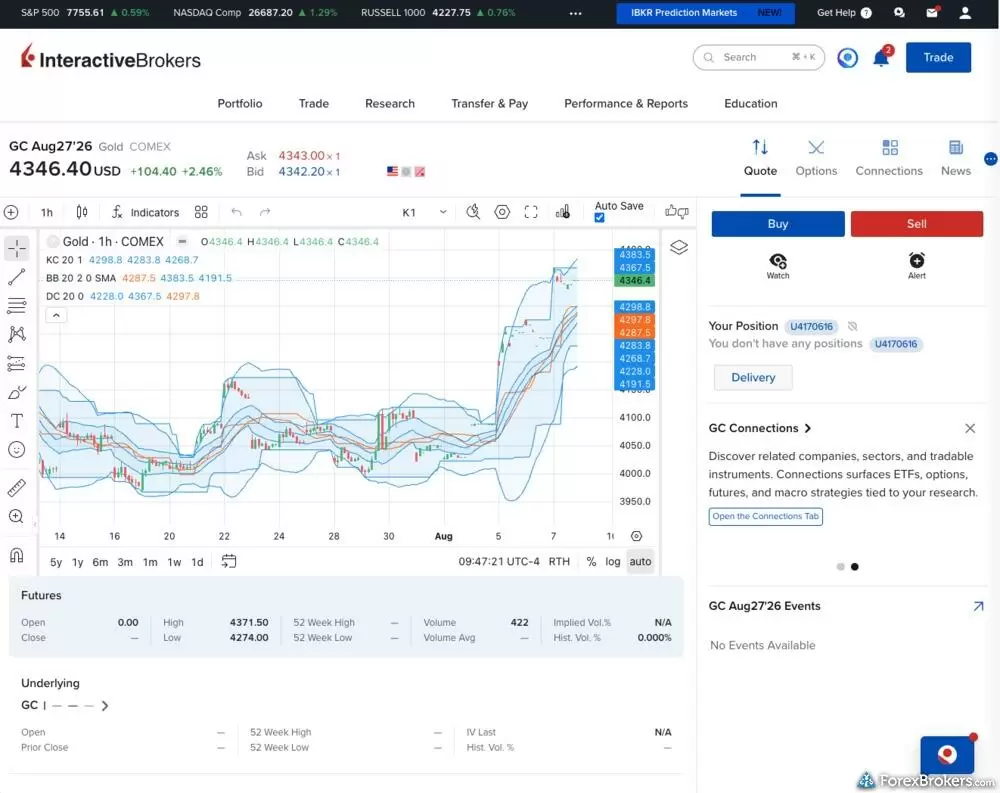
IBKR’s Client Portal does an excellent job of putting technicals and execution side-by-side. Here, I've loaded up a one-hour COMEX gold futures chart with Keltner, Bollinger, and Donchian channels to track volatility. Having the order ticket anchored right next to the chart makes it incredibly easy to manage positions and track contract events without losing sight of the price action.
2. IG - Best for 24/7, weekend gold trading
IG holds my 2026 Annual Award for #1 Overall Broker, and while IBKR takes the top spot for specialized gold access, IG is a close second thanks to its 24/7 weekend coverage, spot CFDs, futures, and options. IG quotes gold against multiple currencies and offers a micro Spot Gold $1 CFD (sized at one troy ounce) with spreads from 0.1 points.
Trading gold equities: IG's derivatives pricing is highly competitive, but if you want to buy gold-related stocks or ETFs through IG’s UK entity, you’ll pay a £10 commission per trade. For frequent, smaller equity trades, it can get expensive quickly.
Margin and execution: Active traders will appreciate IG's tiered margin schedule, which starts at an accessible 0.50% and scales up with position size. One quirk I noticed when reviewing their futures: IG's gold mini contract is 20% of the main contract size but carries 33% of the margin requirement, unlike their other metals minis where both scale evenly.
Weekend market access: IG’s weekend market lets you trade gold on Saturdays and Sundays to hedge off-hours market news. When trying it out, I noticed IG lists "Weekend Gold" as a completely separate market on the platform, and because fewer people are trading over the weekend, the spread widens to 2.5 points (up from 0.3 during the week) and guaranteed stops are disabled.
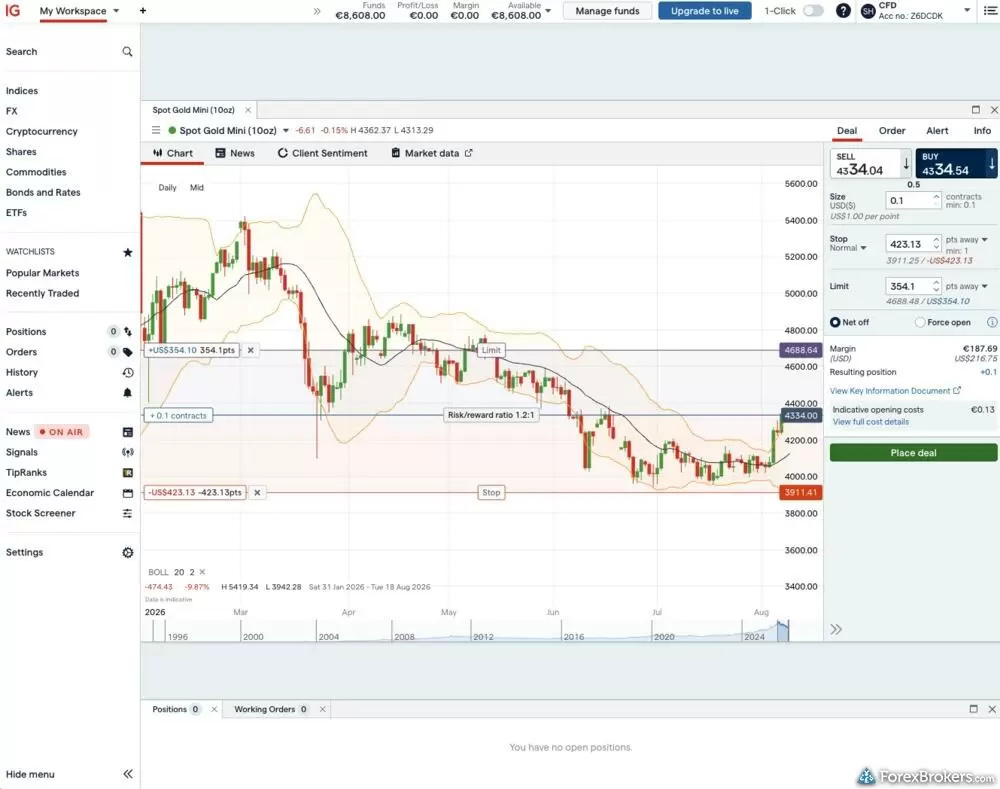
What I love about IG’s web interface is how visual the order management is. On this daily chart for a Spot Gold Mini, you can see exactly where the entry, stop, and limit targets sit relative to the Bollinger Bands. The deal ticket calculates your margin and risk-to-reward ratio (in this case, 1:2.1) before you even hit execute, taking the guesswork out of sizing your trade.
3. Capital.com – Best for small accounts and fractional contracts
Capital.com made my list of the best gold trading brokers by making gold trading accessible to smaller-budget accounts. Ranking among my top low-cost brokers, Capital.com combines a $20 minimum deposit with spread-only pricing from 0.3 points and a micro trade size of 0.01 contracts (1/100th of an ounce), meaning you can open a live gold CFD position with just a few dollars of margin outlay. Check out my in-depth write-up of Capital.com's commissions and fees.
Trading gold: When testing Capital.com’s web platform, funding an account to trade gold was seamless. Beyond standard spot CFDs, Capital.com offers gold futures CFDs, Knock-Out (KO) options, and full integration with TradingView, MT4, and MT5 for traders who prefer third-party platforms.
Fees and currency conversion: While there are no per-trade commissions, holding positions overnight incurs a small daily financing fee (roughly 0.015% for longs). Crucially, this fee applies to the total value of your gold trade, not just the small margin deposit you put down. Also, because gold trades in US Dollars, anyone funding an account in EUR or GBP pays a 0.7% conversion fee on any final profit or loss.
Weekend market limitations: Capital.com falls behind IG in its off-hours coverage. Its gold market opens only for a short window on Sunday evening rather than providing full weekend trading, which means you can’t react to major Saturday or Sunday news headlines in real time.
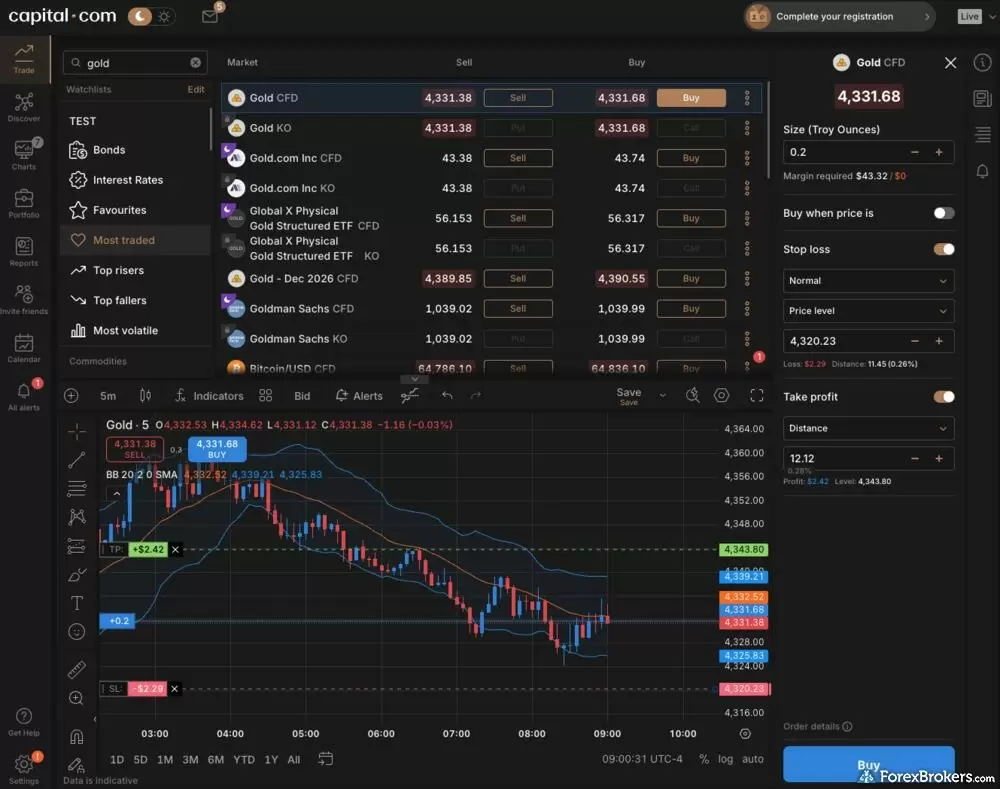
Capital.com’s workspace is exceptionally clean for how much data it handles. I like keeping the market quote table up top to track standard gold CFDs alongside knock-out options. On the 5-minute chart below, you can adjust your stop loss and take profit levels visually by dragging the lines. Meanwhile, the right-side ticket makes it simple to dial down your contract sizing into micro troy ounces while instantly checking your required margin.
4. CMC Markets - Best for thematic metals index trading
CMC Markets made my list because it gives traders versatile market access without demanding a large account balance. Alongside deep charting and research tools, CMC offers micro gold contracts sized at 0.1 (one-tenth of an ounce), letting smaller accounts manage exposure with tight precision.
Leverage and risk controls: For accounts qualifying for maximum leverage (up to 200:1), margin starts at just 0.50%, meaning you can control $1,000 of gold with $5 upfront. If you want protection against sharp market reversals, CMC’s Guaranteed Stop-Loss Orders (GSLOs) carry a tight 2-point minimum distance for reliable downside protection.
Thematic metals basket: My favorite feature is the broker’s proprietary Precious Metals Index. Instead of betting solely on gold, this unique index lets you trade gold, silver, platinum, and palladium together in a single click.
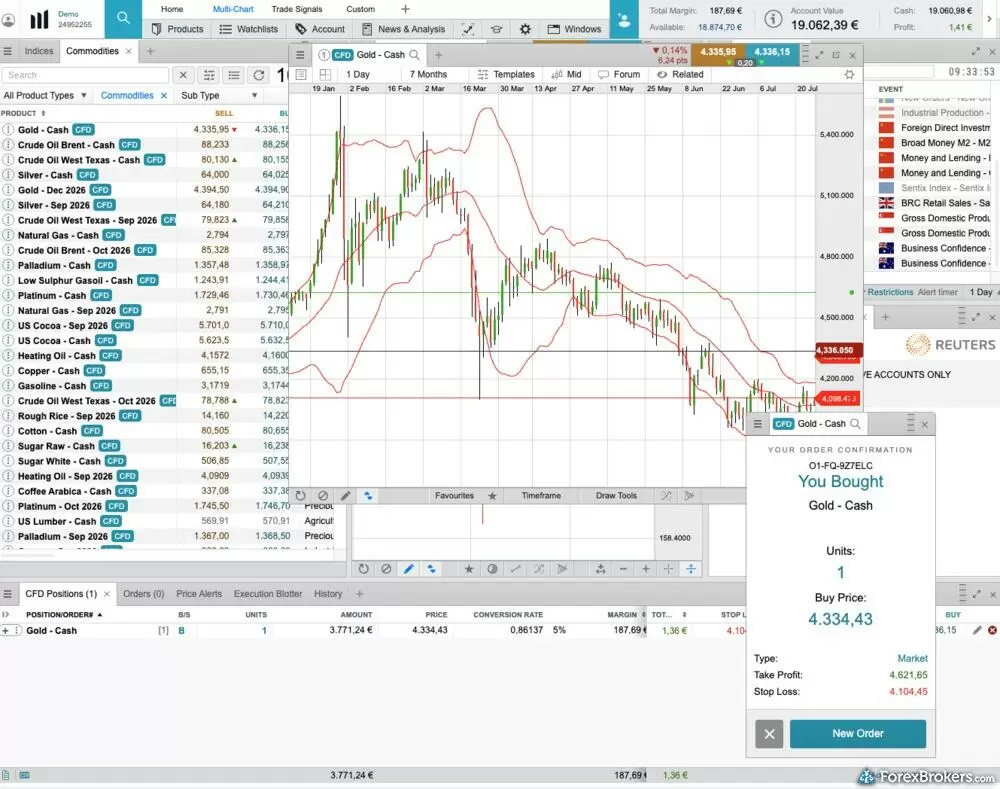
CMC’s Next Generation platform lives up to its name when it comes to customizability. Here, I've set up a classic multi-window layout: a commodities watchlist on the left, active gold charting in the center, and a live Reuters news feed on the right to track macro updates. The order confirmation overlay is a nice touch, giving you a clear summary of your entry and risk levels the second your gold position is filled.
5. Saxo Bank - Best for high-volume traders and gold options
If you're moving serious volume, Saxo lets you hold up to $25 million in gold exposure with an initial margin of just 5% (20:1 leverage).
Advanced platform features: I’ve long been a fan of the SaxoTrader platform. Right inside the trade ticket, you can switch seamlessly between a Gold CFD, a Forward contract, or a listed option. If you right-click an open CFD position, a shortcut menu instantly offers seven predefined options hedging strategies, including straddles, strangles, and seagulls, letting you manage risk in a single click.
Pricing: While Saxo shines for whales, it’s not great for low cost trading. Trading less than 50 contracts incurs a minimum $3.00 commission on CFDs (on top of the spread) and a $10 ticket fee per side for options. However, if you are trading over 50 ounces, those options ticket fees drop to zero, making Saxo the go-to choice for high-volume traders.
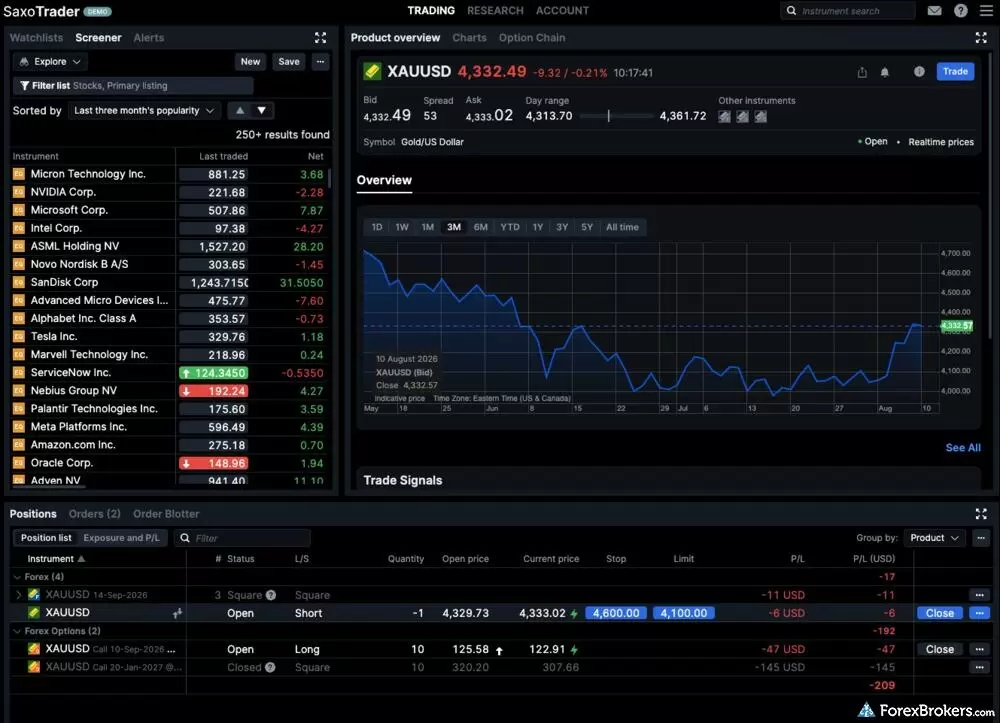
SaxoTrader is built for serious volume, and the modular workspace reflects that. I use the screener on the left to track momentum across major assets, while the detailed product overview for spot gold provides everything from daily ranges to integrated trade signals. The bottom panel keeps your open forex and options positions perfectly organized, giving you real-time tracking of running P&L and risk thresholds at a glance.
Other gold trading platforms I tested
6. FOREX.com - Best for TradingView integration
FOREX.com stands out for international traders by pairing institutional-grade execution, backed by its parent company, StoneX (NASDAQ: SNEX), with impressive platform flexibility. FOREX.com natively integrates with TradingView for advanced charting and includes support for the full MetaTrader suite.
Weekend CFDs: FOREX.com’s gold CFDs feature 24/7 weekend trading and spreads starting at 0.10 points. Institutional backing also allows high-capacity trading, offering 5% margin on massive positions up to 10,000 troy ounces, supported by Guaranteed Stop-Loss Orders (GSLOs).
7. eToro - Best for copy trading
eToro is best known for its social copy trading, but it also provides a surprisingly diverse lineup of instruments for trading gold. Alongside standard daily and 24/7 weekend gold CFDs, the platform offers CME Group’s 1-Ounce and Micro Spot-Quoted Futures (SQFs), giving smaller accounts accessible, exchange-traded exposure.
Social insights: While eToro’s baseline spreads aren't the tightest, its community tools add real value. Inside the options feed, for instance, you can see which specific contracts other users are buying on the GLD ETF, a handy feature for crowdsourcing trade ideas.
8. XTB – Best for xStation charting
XTB makes gold CFDs accessible for smaller accounts with a micro minimum trade size of 0.1 troy ounces (0.001 lots). However, its 0.9-point target spread is noticeably wider than competitors like IG or Capital.com, making it less suited for high-frequency trading.
Platform and usability: XTB offsets its wider pricing through its flagship xStation 5 platform. It delivers nearly 24/5 weekday execution, exceptional charting, and top-tier market research tools that cater well to swing traders analyzing broader macro trends.
ForexBrokers.com Overall Rankings
Now that you've seen our picks for the best brokers on this guide, check out ForexBrokers.com's overall broker rankings. We've evaluated 36 forex brokers, using a testing methodology that's based on 100+ data-driven variables and thousands of data points. Also take a look at our full-length, in-depth forex broker reviews.
Gold Trading Broker Reviews
IG offers the ultimate comprehensive trading package, featuring excellent trading and research tools, and industry-leading education.
Steven Hatzakis August 04, 2026
Interactive Brokers forex review: I tested IBKR's spreads, commissions, and platforms in 2026. More than 100 pairs, but a $2 minimum commission per order.
Steven Hatzakis September 28, 2026
Is Capital.com worth it in 2026? Our expert review covers 450+ crypto CFDs, a 0.7-pip EUR/USD spread, commission-free pricing, and platform quality.
Steven Hatzakis July 21, 2026
CMC Markets review 2026: 303 forex pairs (the most we track), 21,000+ CFDs, and top-tier charting. See where its spreads and education fall short.
Steven Hatzakis September 15, 2026
Saxo is an exclusive multi-asset broker with brilliant research and a superb trading platform experience, along with an extensive selection of over 71,000 securities.
Steven Hatzakis September 10, 2026Related Guides
ForexBrokers.com's list of the seven best forex signals providers and supporting forex brokers for 2026.
Steven Hatzakis September 15, 2026
Not all mobile apps offer traders the same forex trading capabilities. This guide covers which brokers offer the best forex trading apps in 2026.
Steven Hatzakis September 15, 2026
Our team has spent countless hours opening demo accounts, navigating forex platforms, and conducting market research to evaluate forex and CFD broker offerings.
Steven Hatzakis July 10, 2026
For our 2026 Forex Broker Review we assessed, rated, and ranked 32 international forex brokers. Here are our findings.
Steven Hatzakis September 15, 2026
Check out our picks for the best brokers offering the popular ZuluTrade platform and learn about the features that make it a popular choice for copy traders.
Steven Hatzakis May 15, 2026More Guides
- Best CFD Trading Platforms for 2026
- Best High-Frequency Trading Software for 2026
- Best Forex Demo Accounts for 2026
- Best Crypto Brokers for 2026
- Best Trading Platforms for Mac Users of 2026
- Best Brokers for TradingView for 2026
- Best Brokers that Use TipRanks in 2026
- Best PayPal Forex Brokers for 2026
- Best Forex Brokers with APIs for 2026
- Best Algo Trading Software for 2026
- Best Free Forex Trading Courses for 2026
- Best Market Maker Brokers in 2026
- Best MetaTrader 4 (MT4) Brokers for 2026
- Best Forex Options Brokers for 2026
- Best Forex Day Trading Platforms for 2026
- Best Forex Signal Providers for 2026
- Best High-Leverage Forex Brokers for 2026
- Best MetaTrader 5 (MT5) Forex Brokers for 2026
Forex Risk Disclaimer
There is a very high degree of risk involved in trading securities. With respect to margin-based foreign exchange trading, off-exchange derivatives, and cryptocurrencies, there is considerable exposure to risk, including but not limited to, leverage, creditworthiness, limited regulatory protection and market volatility that may substantially affect the price, or liquidity of a currency or related instrument. It should not be assumed that the methods, techniques, or indicators presented in these products will be profitable, or that they will not result in losses. Read more on forex trading risks.
About the Editorial Team
Steven Hatzakis is the Global Director of Online Broker Research for ForexBrokers.com. Steven previously served as an Editor for Finance Magnates, where he authored over 1,000 published articles about the online finance industry. A forex industry expert and an active fintech and crypto researcher, Steven advises blockchain companies at the board level and holds a Series III license in the U.S. as a Commodity Trading Advisor (CTA).
John Bringans is the Managing Editor at ForexBrokers.com. An experienced media professional, John has a decade of editorial experience with a background that includes key leadership roles at global newsroom outlets. He holds a Bachelor’s Degree in English Literature from San Francisco State University, and conducts research on forex and the financial services industry while assisting in the production of content.
Joey Shadeck is a Content Strategist and Research Analyst for ForexBrokers.com. He holds dual degrees in Finance and Marketing from Oakland University, and has been an active trader and investor for close to ten years. An industry veteran, Joey obtains and verifies data, conducts research, and analyzes and validates our content.