 IG
IG FOREX.com
 CMC Markets
 XTB
XTB eToro
eToro Capital.com
 AvaTrade
 Pepperstone
 FP Markets
 Tickmill
MetaTrader 4 (MT4) vs MetaTrader 5 (MT5)

Written by Steven Hatzakis
Director of Online Broker Research

Edited by John Bringans
Managing Editor

Fact-checked by Joey Shadeck
Research Analyst
Steven HatzakisDirector of Online Broker Research
Steven Hatzakis is the Global Director of Online Broker Research for ForexBrokers.com. He is a forex industry expert and an active fintech and crypto researcher.


 Why you can trust us
Led by Steven Hatzakis, Global Director of Online Broker Research, the ForexBrokers.com research team collects and audits data across more than 100 variables. We analyze key tools and features important to forex and CFD traders and collect data on commissions, spreads, and fees across the industry to help you find the best broker for your needs.
We also review each broker’s regulatory status; this research helps us determine whether you should trust the broker to keep your money safe. As part of this effort, we track 100+ international regulatory agencies to power our proprietary Trust Score rating system.
Our researchers open personal brokerage accounts and test all available platforms on desktop, web, and mobile for each broker reviewed on ForexBrokers.com. Learn more about how we test.
The differences between MetaTrader 4 (MT4) and MetaTrader 5 (MT5) have long been debated among forex traders. In this guide, I'll walk you through the ins and outs of the MT4 vs. MT5 question and share the best brokers that offer both.
I first started using the MetaTrader suite in 2005. Since then, I've tested hundreds of trading platforms, placed thousands of trades, logged hundreds of hours of backtesting, and reviewed the MetaTrader offerings of dozens of forex brokers.
Best MetaTrader brokers
I've tested over 60 forex brokers (read more about how we test) and evaluated the top MetaTrader offerings to produce our list of the best forex brokers that offer both MetaTrader 4 and MetaTrader 5:
- Minimum Deposit: $200
- Trust Score: 83
- Tradeable Symbols (Total): 7435
IC Markets’ competitive pricing and scalable execution make it an excellent option for algorithmic traders. Though it supports an impressive range of third-party tools and plugins, IC Markets’ research and education offerings are not as impressive as those offered by industry leaders. Read full review
- Competitive pricing and low average spreads.
- 3,500+ tradeable symbols and powerful algo trading support.
- MetaTrader broker with integrated third-party plugins.
- Educational content and research still have room for improvement.
- No proprietary forex trading app.
- Share trading is limited to Aussie stocks via IC Shares.
- Minimum Deposit: $10
- Trust Score: 94
- Tradeable Symbols (Total): 1726
Pepperstone offers a growing range of tradeable markets, good-quality research, and support for multiple social copy trading platforms. Read full review
- Won Best in Class for MT5, algo trading, and more.
- Offers MetaTrader and cTrader for algo and copy trading.
- Razor account pricing is competitive for active traders.
- New mobile app has solid features and strong usability.
- Education lacks depth.
- MT5 offering has limited symbols.
- Minimum Deposit: $100 AUD
- Trust Score: 90
- Tradeable Symbols (Total): 10000
FP Markets shines as a low-cost broker for trading forex and CFDs – as long as you use the MetaTrader platform. The Iress platform suite offers well over 10,000 tradeable symbols, but it’s mostly a share trading platform – and is generally a much pricier option. Read full review
- Ultra-competitive spreads on Raw ECN account.
- Supports MetaTrader, cTrader, TradingView, and Autochartist tools.
- Access to 10,000+ tradeable symbols via the Iress platform.
- Mobile app lacks in tools and charting.
- Research and education content trails leading brokers like IG.
- Iress platform fees add up.
- Minimum Deposit: $100
- Trust Score: 99
- Tradeable Symbols (Total): 5500
FOREX.com is a trusted brand that delivers an excellent trading experience for forex and CFDs traders across the globe. It offers a wide range of markets and provides an impressive suite of proprietary platforms – alongside limited access to MetaTrader. Read full review
- Trading Academy is great for all experience levels.
- Advanced charting through TradingView with 5,500+ symbols.
- Pro-grade trading tools on web and desktop.
- Spreads are higher than other low-cost brokers.
- Pricing is average unless you qualify for active trader discounts.
- Stock and futures trading require a separate StoneXone account.
- Minimum Deposit: $100
- Trust Score: 80
- Tradeable Symbols (Total): 239
Exness is a global forex broker best known for its flexible execution, instant withdrawals, and access to extremely high leverage, alongside multiple account types and a growing ecosystem of trading tools. Read full review
- Innovative web platform with drag-to-modify order features.
- Wide forex coverage with 96 pairs and flexible account types.
- MetaTrader, Trading Central, and social trading all supported.
- Newly improved educational content on the Insights blog.
- Research content is limited and lags behind top-tier brokers.
- Narrow product range with just over 200 total tradeable symbols.
- Spreads on Standard Cent accounts are higher than other account types.
- Minimum Deposit: $100
- Trust Score: 85
- Tradeable Symbols (Total): 637
Tickmill is a run-of-the-mill MetaTrader broker that offers a limited selection of tradeable securities. The broker does offer very competitive commission-based pricing for professionals through its VIP and Pro accounts. Read full review
- Offers the full MetaTrader suite with platform add-ons.
- Supports algo trading and pro-level tools like CQG.
- Trading signals powered by Signal Centre and Acuity.
- Lags top brokers in asset variety.
- Classic account pricing is average; VIP account was removed.
- Autochartist, Pelican, and Capitalise.ai were removed in 2025.
- Minimum Deposit: $0
- Trust Score: 99
- Tradeable Symbols (Total): 21710
CMC Markets is well-trusted across the globe, and delivers a terrific trading experience thanks to its 21,710 tradeable instruments and 303 forex pairs, the largest currency lineup in the industry. Read full review
- 21,710 instruments and 303 forex pairs available.
- Next Gen platform is packed with tools and charts.
- Client sentiment and pattern recognition built into the platform.
- Zero minimum deposit and no fee on international wire transfers.
- MetaTrader 4 has fewer symbols and limited product depth.
- Standard-account EUR/USD spread of 1.3 pips has widened year over year.
- No automated trading on CMC's proprietary platform.
- Education lacks progress tracking or interactive features.
- The quantity of research content produced has slowed.
CFDs are complex instruments and come with a high risk of losing money rapidly due to leverage. Between 51% and 89% of retail investor accounts lose money when trading CFDs. You should consider whether you understand how CFDs work and whether you can afford to take the high risk of losing your money.
Top picks for MetaTrader brokers
1. IC Markets – Best MetaTrader broker
| Company | Minimum Deposit | MetaTrader 4 (MT4) | MetaTrader 5 (MT5) |
 IC Markets IC Markets
|
$200 | Yes | Yes |
IC Markets stands out for its MetaTrader offering for a number of reasons that help make it the best overall broker in this category for 2026.
Algorithmic trader focus: MetaTrader platforms support algorithmic trading and IC Markets provides multiple account types and execution methods coupled with an order execution policy that permits you to deploy a wide variety of trading strategies to fully take advantage of algo trading. This distinction is important because, before I deploy an algo strategy, I want to make sure the execution method is reliable for the sort of trades it will be making. IC Markets shines for its ability to execute very large trading volumes driven by algorithm trading systems across its MetaTrader and cTrader platforms.
High-volume traders: IC Markets has very competitive pricing across its MetaTrader platforms and the numerous account types available, including recently enhanced active trader pricing via its Raw Trader Plus rebate program. This results in great savings for traders operating at high volume.
Copy trading and platform add-ons: IC Markets offers multiple copy-trading platforms. When you couple this with its low pricing and robust order execution policies, MetaTrader becomes a viable option to launch trading signals that you may want to share, either on the MQL4 signals market or through compatible third-party copy trading platforms, such as ZuluTrade. IC Markets also provides multiple plugins and platform add-ons specifically for the MetaTrader platform suite to enhance the default experience.
Steven's take:
After 20-plus years of running algo strategies, I judge a broker by its execution before anything else. IC Markets' Raw Trader Plus pricing and reliable fills across MetaTrader and cTrader are what make it my top pick for high-volume automated trading.
Steven Hatzakis
Director of Online Broker Research
Wide range of markets: MetaTrader 5 (MT5) at IC Markets supports a wider selection of tradable instruments than its MetaTrader 4 (MT4) offering. This is true at most brokers as MT5 can handle more assets, such as shares, compared to the more forex-focused MT4.
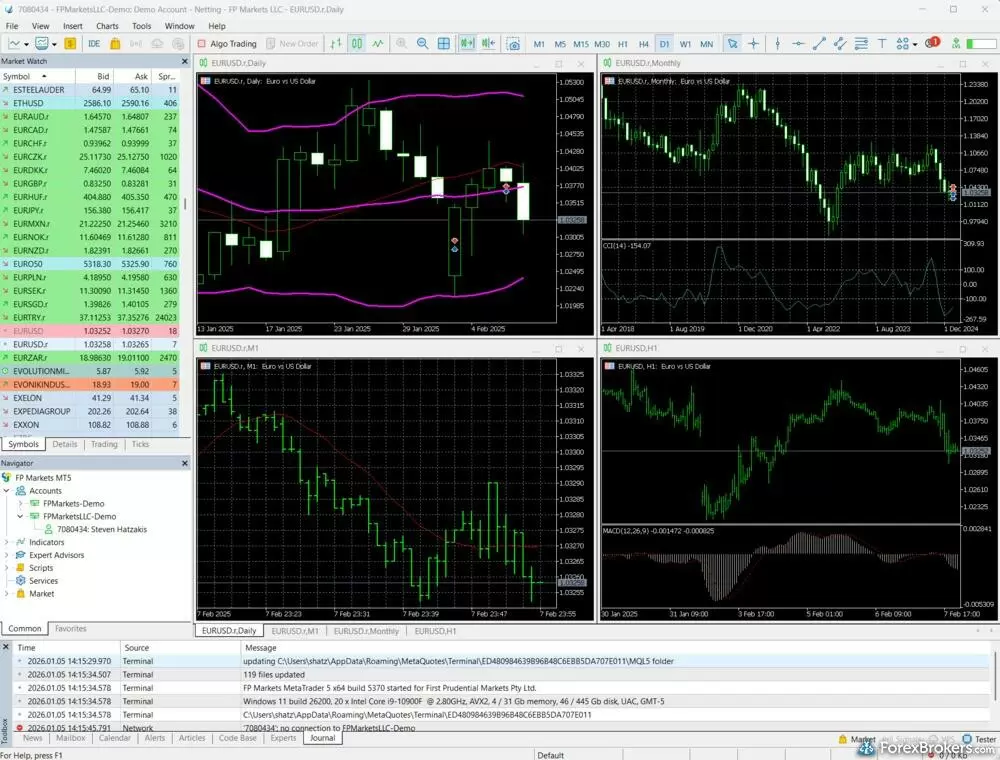
IC Markets MT5 desktop platform, with four charts in tiled mode, and Bollinger Band indicator with purple lines running on the EUR/USD pair, running on Windows 11. The Journal tab is featured on the bottom Toolbox pane, and to the left is the Navigator showing the FP Markets account, and the Market Watch panel above with the Symbols watchlist loaded, displaying available currency pairs and CFDs.
2. Pepperstone – Great for MetaTrader and copy trading
| Company | Minimum Deposit | MetaTrader 4 (MT4) | MetaTrader 5 (MT5) |
 Pepperstone Pepperstone
|
$10 | Yes | Yes |
Pepperstone has a well-balanced offering when comparing its account types, range of markets, trading costs, market research, educational content, and copy trading. I recommend its MT5 account offering over its MT4 platform, as the former should meet the needs of most traders when combined with its Razor account.
Extensive range of platforms available: Pepperstone's MetaTrader offering comes with platform add-ons as part of its Smart Trader Tools package, and features low effective spreads on its commission-based Razor accounts.
Algorithmic trader support: Pepperstone is also fantastic for MetaTrader due to its robust order execution policy for algorithmic traders, which is suitable for trading during volatile news events and even permits scalping (trading very fast at very small time intervals). Beyond MetaTrader, Pepperstone also offers TradingView and cTrader, both of which support algorithmic trading and can be suitable alternatives to MT4 or MT5. Finally, Pepperstone has a robust Active Trader program to help lower costs for traders that do significant monthly turnover.
Copy trading options: Pepperstone has offered copy trading platforms for years, with its latest addition being its own branded copy trading platform, powered by Pelican. In addition, DupliTrade is available for cTrader accounts (although not within the EU), alongside SignalStart which is compatible with MetaTrader. All of these copy trading platforms have their pros and cons, but having the selection from within the same broker, alongside a wide variety of platforms and other well-balanced offerings, helps Pepperstone stand out in this category among other MetaTrader brokers.
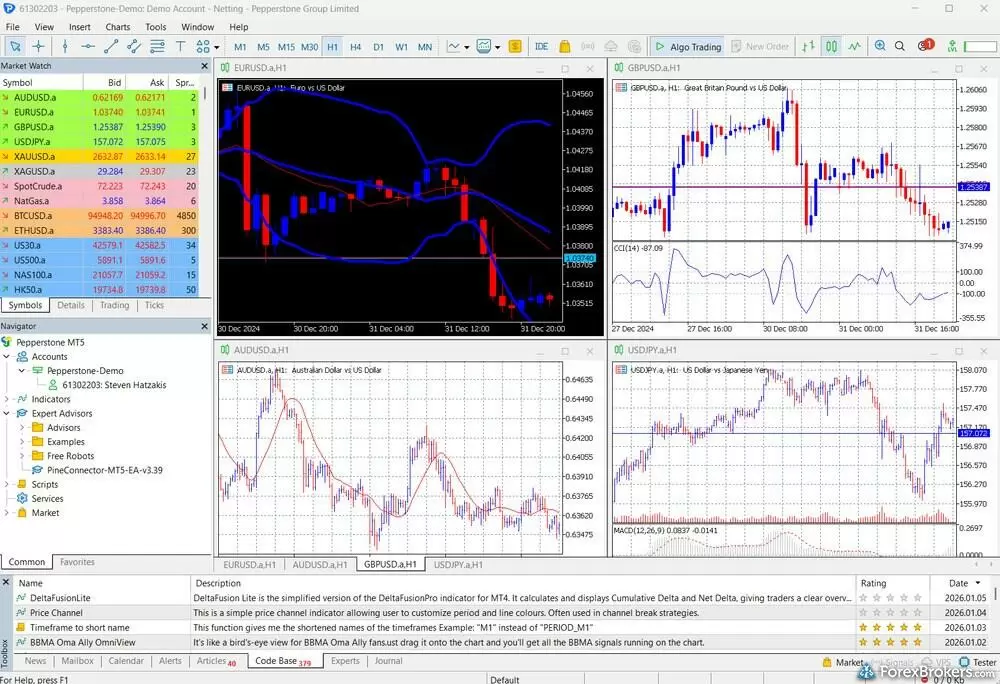
Pepperstone's MetaTrader 5 (MT5) desktop platform shows a classic layout with four charts in tiled mode, the Market Watch watchlist on the side, the Navigator panel listing accounts and available Expert Advisors, indicators, and scripts, and the Code Base tab opened in the Toolbox along the bottom.
3. FP Markets – Excellent pricing, great for MetaTrader
| Company | Minimum Deposit | MetaTrader 4 (MT4) | MetaTrader 5 (MT5) |
 FP Markets FP Markets
|
$100 AUD | Yes | Yes |
FP Markets stands out for its low effective spreads (low average spreads coupled with low per-trade commissions) across its MetaTrader RAW account offering, making it a great low-cost option for MetaTrader in 2026. Similar to most brokers, I prefer its MT5 offering over MT4 due to the range of markets and pricing offered on its MT5 accounts.
Wide variety of markets and platforms: FP Markets also offers a wide variety of tradable instruments, including forex and CFDs, across both its MetaTrader platform and on its Iress and Mottai platforms - with direct market access to CFD trading on local and regional exchanges in Australia.
Platform add-ons: FP Markets Traders Toolbox, developed by FX Blue, comes with 12 platform plugins which are great for enhancing the default MetaTrader platform setup. For instance, there are custom tools like the correlation matrix and trading interface, a session map, a sentiment trader, a mini-terminal, and other trading tools that launch within the MetaTrader platform (once individually installed).
Copy trading: In addition to the native signals market within the MetaTrader platform, FP Markets offers the Myfxbook Autotrade copy trading service which integrates with MetaTrader directly. Furthermore, FP Markets recently launched its own Social Trading platform with over 500 signal providers available.
Visit my full review of FP Markets to learn more about its pricing, range of markets, and available platforms.

Viewing the chart layout and current watchlist on the FP Markets' MetaTrader 5 MT5 desktop platform.
4. FOREX.com - Great for educational content
| Company | Minimum Deposit | MetaTrader 4 (MT4) | MetaTrader 5 (MT5) |
 FOREX.com FOREX.com
|
$100 | Yes | Yes |
FOREX.com is one of the few brokers to offer both MT4 and MT5 to U.S. clients, alongside its proprietary platform suite. You'll need a dedicated MT4 account to access that platform, but the flexibility across account types lets you match pricing to how you trade.
Tools that build on the default setup. FOREX.com bundles nine Expert Advisors and 15 custom indicators free for both MT4 and MT5, plus FX Blue sentiment data and Trading Central. For active traders, volume-based pricing discounts help bring down effective costs the more you trade.
My take. As part of StoneX (NASDAQ: SNEX), FOREX.com pairs the MetaTrader suite with the backing of a well-capitalized public company, which matters when you're choosing where to run your strategies.
5. Exness - Good range of account options
| Company | Minimum Deposit | MetaTrader 4 (MT4) | MetaTrader 5 (MT5) |
 Exness Exness
|
$100 | Yes | Yes |
Exness offers both MT4 and MT5 across desktop, web, and mobile, alongside its proprietary Exness Terminal. When I tested across 78 forex pairs, I appreciated that MT5 is available on every account type, so you're not boxed into one platform based on your pricing.
A standout proprietary option. Terminal is built on a TradingView chart engine with 106 technical indicators, and the feature I rate highest is being able to set stop-loss and take-profit levels before a trade is even open, then drag each marker on the chart. Most platforms reserve that for after the position fills.
Low fees. With a $10 minimum and strong execution, Exness suits cost-conscious active traders. Just note that it operates only in select regions and isn't available to U.S. clients, so check that it serves your country before signing up.
Other MetaTrader brokers I tested
6. Tickmill - Best overall broker for low costs
| Company | Minimum Deposit | MetaTrader 4 (MT4) | MetaTrader 5 (MT5) |
 Tickmill Tickmill
|
$100 | Yes | Yes |
Tickmill is built for serious, cost-conscious traders. Among the MT4 brokers I tested, its Raw account delivered the lowest all-in cost at 0.70 pips on EUR/USD, and it supports MT4 and MT5 with full algo and scalping access. An FX Blue Advanced Trading Toolkit enhances the default setup, and a BeeksFX VPS discount helps low-latency strategies. Note that Tickmill doesn't accept U.S. clients, so confirm availability in your region.
7. CMC Markets - Great web platform
| Company | Minimum Deposit | MetaTrader 4 (MT4) | MetaTrader 5 (MT5) |
 CMC Markets CMC Markets
|
$0 | Yes | Yes |
CMC Markets pairs the MetaTrader suite with competitive forex pricing on its FX Active account. MT4 is available globally, while MT5 is limited to select regions including the U.K., Australia, and Canada. FX Active carries minimum spreads of zero pips and commission of 0.0025% of notional per side, averaging 0.65 pips on EUR/USD, or 1.15 pips all-in. CMC won our 2026 award for #1 Most Currency Pairs, quoting 303 pairs across its platforms.
MT4 vs. MT5: Key differences
Though MT4 and MT5 look nearly identical on the surface, the two platforms differ in meaningful ways. Below, I break down where they diverge across technical analysis tools, hedging and netting, cost, and tradeable symbols, then summarize the top MT5 features that set it apart from its predecessor.
Technical Analysis Tools
Technical analysis tools enable traders to assess investments and identify trading opportunities in the market - whether they are bullish, bearish, or sideways. Common tools for technical analysis include charts, drawing tools, and backtests.
Here, MT5 outshines MT4.
Charting:
The MT5 platform delivers a wider range of default studies with 38 technical indicators, 44 analytical objects, and 21 time frames. Because of MT5’s processing capabilities, certain custom indicators and strategies can only run on MT5.
Meanwhile, MT4 only provides studies with 30 technical indicators, 23 analytical objects, and 9 time frames.


Drawing Tools:
Also known as analytical objects, these annotation tools enable traders to mark chart lines, channels, tools, geometric shapes, symbols, and graphical objects, but they differ from technical indicators in that they must be plotted manually. MT5 gives you greater precision and more options for marking up your charts.


Strategy Tester:
MT5’s revamped Strategy Tester supports multi-core and multi-threaded backtests optimized for 64-bit machines. As a result, MT5 has a greater capacity to handle large backtest projects (a backtest that takes a few hours on MT5 might take hundreds of hours to perform on MT4).

Hedging
You can use both MT4 and MT5 to hedge your trades (learn more about hedging by checking out my full guide on forex hedging), but MT5 offers the added functionality of being able to net your trades. Let’s say you have an open trade. Under MT5’s netting system, if you open a trade on the same market in the opposite direction, your initial trade will be closed, lowered in volume, or reversed.
Find a hedging forex broker
Hedging isn't permitted by every broker or in every region. Check out my guide to the best hedging brokers to find a broker that allows you to explore a hedging strategy.
Cost
MT4 and MT5 are both free to use for retail forex traders (though your forex broker will need to offer the platforms to its clients). It’s worth noting that forex brokers offering MT4 and/or MT5 may still charge you commissions, spreads, fees, or a combination of such trading costs (depending on the broker and its account offering). Looking for a low-cost broker? Check out my guide to the Best Zero Spread Brokers to find forex brokers with the lowest spreads in the industry.
Tradeable symbols
Since forex brokers license MetaTrader platforms from MetaQuotes, the total tradeable symbols available will vary by broker. It’s worth noting that the developer has imposed a symbol cap on MT4. For example, CMC Markets has over 12,000 total tradeable symbols on its CMC Next Generation platform, but the symbol cap limits CMC Markets’ MT4 offering to 1,024 instruments.
FAQs
What is MetaTrader 4 (MT4)?
MetaTrader 4 (MT4) is arguably the world’s most well-known forex trading platform. It belongs to the MetaTrader suite of trading platforms developed by MetaQuotes Software Corp. In the nearly 20 years since its launch (2005), MT4 has become known for its customizable functions, wide range of built-in technical indicators, integrated programming language, automated trading capabilities, and sophisticated analysis tools.
MetaTrader 4 is not a broker; it is a third-party trading platform that connects to a forex broker for forex trading. You’ll still need to choose a great forex broker, whether you use MT4 or MT5.
MT4 remains wildly popular
MT4 has been downloaded over 10 million times from the Google Play store and holds a rating of 4.8 stars (with over 68,000 user ratings) in Apple’s App Store. MT4 is available for desktop and as a mobile trading app.
What is MetaTrader 5 (MT5)?
MetaTrader 5 is a next-generation trading platform and the successor to MetaTrader 4. Like MT4, MT5 is free to use (so long as your forex broker has paid to license the platform for its clients). Though the two platforms have a similar look, MT5’s wider range of tradeable instruments can better meet the needs of multi-asset traders looking to trade instruments such as commodities, stocks, CFDs, futures, options, and bonds.
MT5 also offers a deeper set of advanced tools and features, such as the MQL5 programming language, additional graphical objects and indicators, new statistical functions, an enhanced version of Strategy Tester, and the ability to both hedge and net trades.
More about MetaTrader 5
Learn more about MT5’s unique functions by checking out my guide to MetaTrader 5.
Why use MT4 over MT5?
MetaTrader 4 has been on the market for twenty years and has established a strong, loyal client base. MT4 can be used with hundreds of brokers around the world. When deciding between MT4 and MT5, you should always consider the account options, range of markets, and execution methods available to you with your broker’s MetaTrader offering.
Important note:
MetaQuotes Software has announced they will no longer update MT4. Over time, more traders will gravitate towards MT5.
MQL4 vs MQL5: Some traders may choose to use MT4 because they created an Expert using the MQL4 programming language. Bringing that Expert over to MT5 would require rewriting the code in the newer version of MetaQuotes’ programming language (MQL5). This is one of the main reasons why it took so long for many traders to switch over to MT5; the majority of algorithmic trading programs designed for MetaTrader were built for MT4.
Why use MT5 over MT4?
Though MT5 has been slower to gain adoption among forex brokers and retail traders (it took eleven long years for MT5’s use among forex brokers to eclipse MT4), it is beginning to gain momentum among some of the best brokers in the industry. MT5 has officially surpassed MT4 in trading volume since the start of 2025, capturing 54.2% of the combined volume between the two platforms.
Here are just a few reasons to pick MT5 over MT4:
MT5 is a true multi-asset trading platform. Traders using MT5 can trade financial instruments such as commodities, stocks, futures, options, and bonds (MT4 is limited to forex pairs and CFDs).

MT5's MQL5 programming language can handle multi-threading and asynchronous operations, which can carry out faster operations when performing backtesting or executing algorithmic trading via the use of Experts and custom indicators. MT4 meanwhile only supports single-thread operation, which means some complicated programs will take much longer, like backtesting.
MetaTrader 4 and 5 each have their own programming language. MQL5 for MT5 is a cut above MQL4 (MT4’s programming language). MQL5 features specialized elements of C++ which enable developers to build expert advisors (EAs), or trading robots, with a greater level of complexity than was possible with MQL4.
Programmers are able to sell their EAs and indicators in the MQL5 marketplace while still protecting their proprietary code, and these forex robots can be used within MT5’s highly popular algorithmic trading suite. MQL5 even features a development assistant, which enables traders with no programming experience to create very simple trading robots.


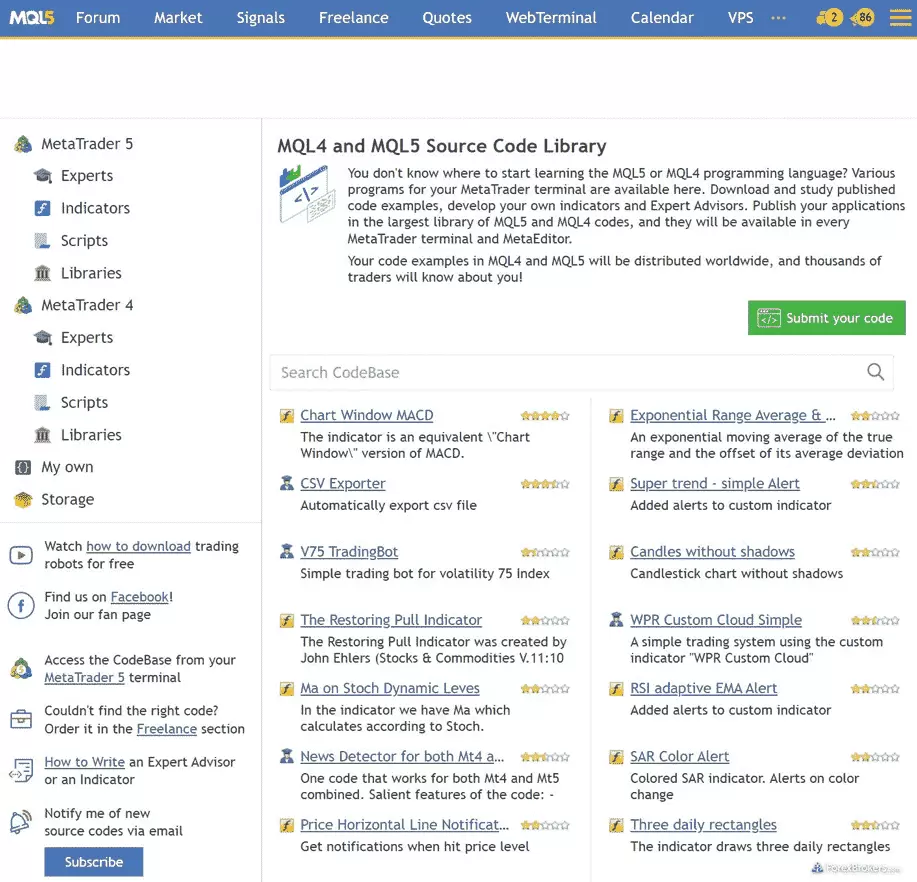
MT5’s DOM Toolbox displays market depth information; trade volumes are displayed alongside asset prices for new positions.

MT5’s Strategy Tester includes new advanced settings and supports multi-threaded backtests in 64 bits, leading to faster backtests than was previously possible. MT5’s Strategy Tester enables traders to test and optimize software built with MQL5 – before the software is run on live accounts with real money at stake.
Pro tip:
If you’re planning to buy an EA from the MT5 Community, use MT5’s Strategy Tester to evaluate the software before purchase. This can also be done using the demo version of the software.
Strategy Tester allows for deep, highly complex backtesting. As an example, I once performed a backtest on MetaTrader that took over 700 hours to complete and ran through 10,000 different scenarios while testing different configurations for various parameters.


MT5's built-in economic calendar can be pinned to charts so you don’t need to visit external news sites to check potential market-moving events. The economic calendar includes descriptions of macroeconomic indicators and their release dates.

MT5 also offers an advanced Secure Sockets Layer (SSL) certificate feature, which digitally binds cryptographic keys to any data transferred between client terminals and platform servers.
An important note about security
Just because MT5 is a secure platform doesn’t mean that your MT5 broker is reputable or regulated. Check out our Trust Score page to learn more about regulation, and read my educational series about forex scams to learn more about the most common scams (and how to avoid them).
Which is better, MT4 or MT5?
Overall MT5 is the better choice for traders of all types. MT5 is the newest version of the MetaTrader platform and thus receives full support from the developer. MT5 is a great choice for traders who are looking for a more powerful, more advanced trading platform than its predecessor. MT5 offers more order types, technical indicators, analytical objects, time frames, and charts. MT5 is also good for traders who want to perform complex backtesting, thanks to its advanced Strategy Tester features. Unless you are still using a specific plugin or algo that hasn't been imported to MT5, there's simply no reason to pick up MT4 instead.
Let’s take a closer look at what’s new with the MT5 trading platform, and what distinguishes it from its predecessor (MT4):
Top 10 MT5 features (compared to MT4):
- MT5 features two new order types: buy stop-limit and sell stop-limit, bringing the total number of order types up to 6 (compared to MT4’s four).
- MT5 charts support up to 44 graphical objects (including technical indicators) compared to MT4’s 24.
- MT5’s expanded number of time frames (21, compared to MT4’s 9) allows traders to choose additional chart types and quote visualizations.
- MT5’s trade execution buttons now feature Tooltips, which display the number of units of a given asset currently being traded.
- Market depth information is now displayed directly within MT5’s terminal window, and trade volumes are displayed alongside the asset price for new positions.
- MT5’s Journal tab has been reorganized to make it easier to track market occurrences.
- MT5 permits both the hedging and netting of trades (only hedging is permitted in MT4), such as First in First Out (FIFO) – which is not supported on MT4.
- New statistical functions have been introduced and added to MT5’s Standard Library.
- MT5’s Strategy Tester features new advanced settings and supports multi-threaded backtests in 64 bits; this allows traders to complete complex backtests much faster than was previously possible.
- MQL5 allows traders to create indicators, scripts, libraries, and forex robots (or, Expert Advisors) and supports many of the existing features that originally made MT4 so popular.
Will MT4 be phased out?
Though MT5 is more feature-rich than its predecessor and has now surpassed MT4 in terms of the number of companies using the platform, no public statements have been made by MetaQuotes indicating that MT4 will be officially phased out. That said, MetaQuotes discontinued support for MT4 client terminal versions below 1065 in 2017 and stopped issuing MT4 licenses to new clients in 2018. For the time being, the MT4 platform is still available for download via the MetaQuotes Software site (here is the link to the MT4 download landing page).
Can I use both MT4 and MT5?
Yes, you can use both MT4 and MT5, so long as your broker of choice is licensed by MetaQuotes Software to offer the full MetaTrader platform suite. Not all brokers offer both MetaTrader platforms; check out my guides to the best MT4 brokers and the best MT5 brokers to see the list of brokers that offer each platform (and find my picks for the best MetaTrader brokers).
Which platform is better for beginners, MT4 or MT5?
MT5 is more widely supported by the developer and my suggestion for a beginner who has yet to begin learning either platform. Brokers often offer a larger range of markets and better pricing (for trading costs and spreads) on their MT5 offering than what is available using MT4 (this of course depends on your broker and your individual trading account).
Though MT4 and MT5 look nearly identical on the surface, there are some notable differences between the two trading platform versions. That said, either platform can be suitable if you are a beginner forex trader. However, just because MT4 offers fewer charts and a less-specialized trading platform doesn’t mean that its user experience is markedly easier for first-time users, and there's always a chance that MT4 is discontinued completely over the next few years.
How does MetaTrader compare to cTrader?
cTrader offers a more modern user interface and sleeker design, as well as a larger number of time frames (26) than MT4 (9) or MT5 (21). I’m a huge fan of cTrader’s charts and it’s great to see the platform enjoy adoption by a decent number of trusted forex brokers. That said, MetaTrader platforms are far more popular and more widely available.
ForexBrokers.com Overall Rankings
Now that you've seen our picks for the best brokers on this guide, check out ForexBrokers.com's overall broker rankings. We've evaluated 36 forex brokers, using a testing methodology that's based on 100+ data-driven variables and thousands of data points. Also take a look at our full-length, in-depth forex broker reviews.
Popular Forex Trading Tools and Platform Guides
- Best MetaTrader 4 (MT4) Brokers for 2026
- Best MetaTrader 5 (MT5) Forex Brokers for 2026
- Best Forex Signal Providers for 2026
- Best Brokers for TradingView for 2026
- Best Trading Central Forex Brokers for 2026
- Best Forex Brokers with Trading APIs
MetaTrader 4 Broker Reviews
Pepperstone offers a growing range of tradeable markets, good-quality research, and support for multiple social copy trading platforms.
Steven Hatzakis June 16, 2026
In my 2026 Exness review, I tested the Exness Terminal, MT4, and MT5 across 78 forex pairs. See my verdict on costs, research, and product range.
Steven Hatzakis May 27, 2026
FOREX.com is a trusted brand that delivers an excellent trading experience for forex and CFDs traders across the globe.
Steven Hatzakis May 04, 2026
IC Markets is built for algorithmic and cost-sensitive forex traders: 0.72 pips all-in on EUR/USD and free colocated VPS, but no platform of its own.
Steven Hatzakis August 31, 2026
FP Markets shines as a low-cost broker for trading forex and CFDs – as long as you use the MetaTrader platform.
Steven Hatzakis September 15, 2026MetaTrader 5 Broker Reviews
In my 2026 Exness review, I tested the Exness Terminal, MT4, and MT5 across 78 forex pairs. See my verdict on costs, research, and product range.
Steven Hatzakis May 27, 2026
IC Markets is built for algorithmic and cost-sensitive forex traders: 0.72 pips all-in on EUR/USD and free colocated VPS, but no platform of its own.
Steven Hatzakis August 31, 2026
FP Markets shines as a low-cost broker for trading forex and CFDs – as long as you use the MetaTrader platform.
Steven Hatzakis September 15, 2026
FOREX.com is a trusted brand that delivers an excellent trading experience for forex and CFDs traders across the globe.
Steven Hatzakis May 04, 2026
Pepperstone offers a growing range of tradeable markets, good-quality research, and support for multiple social copy trading platforms.
Steven Hatzakis June 16, 2026Related Guides
Check out my picks for the best brokers with algo trading software in 2026.
Steven Hatzakis June 12, 2026
Compare the 5 best cTrader brokers of 2026 by spreads, commissions, and minimum deposits. Ranked from hands-on testing across 100+ data-driven variables.
Steven Hatzakis August 14, 2026
We tested and ranked the best forex brokers that offer MetaTrader 5, the popular trading platform developed by MetaQuotes Software.
Steven Hatzakis June 22, 2026
ForexBrokers.com's list of the seven best forex brokers that offer integration with TradingView.
Steven Hatzakis September 16, 2026More Guides
- Best CFD Trading Platforms for 2026
- Best Market Maker Brokers in 2026
- Best Brokers that Use TipRanks in 2026
- Best Forex Options Brokers for 2026
- Best PayPal Forex Brokers for 2026
- Best Crypto Brokers for 2026
- Best Free Forex Trading Courses for 2026
- Best Algo Trading Software for 2026
- Best Forex Demo Accounts for 2026
- Best MetaTrader 4 (MT4) Brokers for 2026
- Best High-Frequency Trading Software for 2026
- Best Trading Platforms for Mac Users of 2026
- Best Brokers for TradingView for 2026
- Best High-Leverage Forex Brokers for 2026
- Best Forex Brokers with APIs for 2026
- Best Forex Day Trading Platforms for 2026
- Best Forex Signal Providers for 2026
- Best MetaTrader 5 (MT5) Forex Brokers for 2026
Popular Forex Guides
- Best Forex Trading Apps for 2026
- Best MetaTrader 4 (MT4) Brokers for 2026
- Best Brokers for TradingView for 2026
- Best Forex Brokers for Beginners of 2026
- Compare Forex Brokers
- International Forex Brokers Search
- Best Copy Trading Platforms for 2026
- Best Forex Brokers for 2026
- Best Low Spread Forex Brokers for 2026
About the Editorial Team
Steven Hatzakis is the Global Director of Online Broker Research for ForexBrokers.com. Steven previously served as an Editor for Finance Magnates, where he authored over 1,000 published articles about the online finance industry. A forex industry expert and an active fintech and crypto researcher, Steven advises blockchain companies at the board level and holds a Series III license in the U.S. as a Commodity Trading Advisor (CTA).
John Bringans is the Managing Editor at ForexBrokers.com. An experienced media professional, John has a decade of editorial experience with a background that includes key leadership roles at global newsroom outlets. He holds a Bachelor’s Degree in English Literature from San Francisco State University, and conducts research on forex and the financial services industry while assisting in the production of content.
Joey Shadeck is a Content Strategist and Research Analyst for ForexBrokers.com. He holds dual degrees in Finance and Marketing from Oakland University, and has been an active trader and investor for close to ten years. An industry veteran, Joey obtains and verifies data, conducts research, and analyzes and validates our content.